Language levels on a CV: use the scale, not adjectives

Language levels are where honest people accidentally overclaim. Fluent means something different to every reader, and the interview is where that shows up.
Fluent, good, conversational, basic. Four words that mean nothing in particular, sitting where a public, checkable scale could sit instead. The Common European Framework of Reference exists precisely so that a recruiter in Rotterdam and one in Vienna read the same claim the same way.
Use the scale, not an adjective
Write the language, the level and nothing else: German C1, Dutch B2, Polish native. The level does the work the adjective was pretending to do, and it does it in a form the reader can act on.
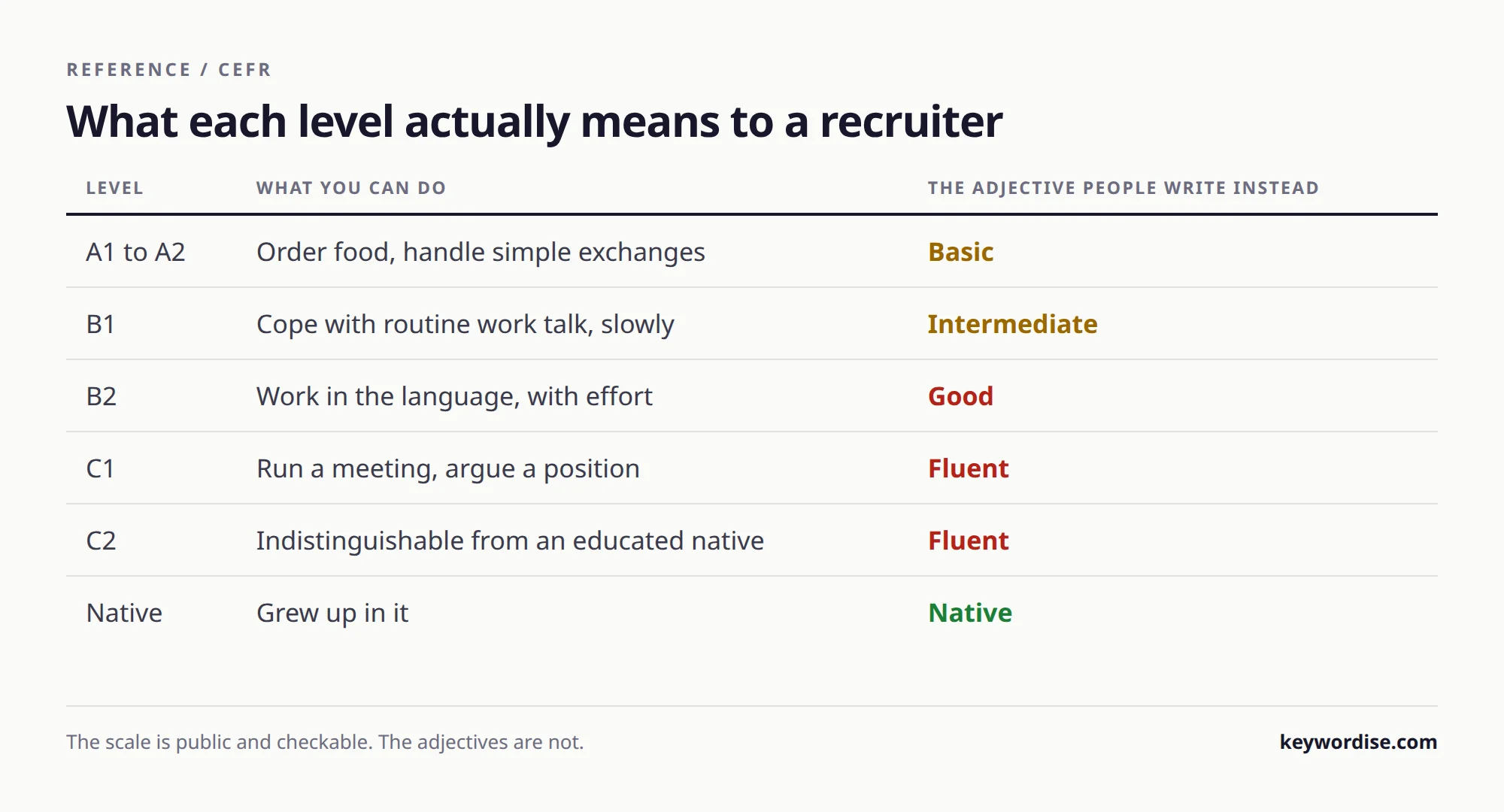
Where the levels get inflated
B2 and C1 are the two most overstated levels on European CVs, and both are easy to test in the first five minutes of a call. The interviewer does not need a language exam: they switch language and ask a question about your last job.
- Claiming C1 when you mean B2 costs you the interview, not the job: you arrive and it shows in the first exchange.
- Understating is nearly as bad. B2 on the CV when you are C1 filters you out of roles you would have held comfortably.
- If you are between levels, name the lower one and add where the higher one applies: German B2, C1 in writing.
- Do not list a language you cannot hold a work conversation in. A1 on a CV is noise.
- Native means you grew up in it. It is not a synonym for very good.
A level is a claim someone can check in ninety seconds. An adjective is a claim they have to test, and testing it is the interview you wanted to be having about your work.
Why the scale beats the adjective
Certificates: when they are worth the line
A certificate earns its place when it is recent, when the role is language-critical, or when a visa or a regulated profession depends on it. Otherwise the level alone is enough, and a fifteen-year-old certificate raises the question of what has happened since.
| Situation | Write | Why |
|---|---|---|
| Everyday application | German C1 | The level is the information |
| Language-critical role | German C1 (Goethe C1, 2024) | The proof belongs next to the claim when the claim is the job |
| Between two levels | German B2, C1 in writing | Honest, and it still clears a B2 filter |
| Grew up bilingual | Polish native, German native | Two natives is normal and worth stating plainly |
Where the languages go on the page
Languages belong in the skills section for most roles, and directly under your name only when the language is the reason you are a candidate at all. Keep them as plain text on one line. Flag icons and five-dot rating graphics are the two versions software cannot read: a parser sees an image and three dots, and stores nothing.
Sources
Every source here was fetched and checked before it was linked.
- Europass, the Common European Framework of Reference levels in full
- National Careers Service, where skills belong on a CV
- Huntr, how applicant tracking systems index skills fields
Stop sending the same CV
Keywordise writes a fresh, truthful CV for every job and applies for you. 7-day free trial, 27 free applications, no card.
Start free →Frequently asked questions
How do I write language levels on a CV?
Language then level, nothing else: German C1, Dutch B2, Polish native. The Common European Framework of Reference scale runs A1 to C2 and is understood across Europe.
What does B2 actually mean?
You can work in the language with effort: follow a meeting, write a clear email, explain your own work. You will still be slower than in your first language and you will miss jokes.
Is C1 fluent?
C1 is where most people mean when they say fluent: you can run a meeting and argue a position. C2 is indistinguishable from an educated native speaker, which is a higher bar than most CVs claiming it can survive.
Should I write fluent instead of a level?
No. Fluent means different things to different readers and it is the word interviewers test first. A level is checkable in ninety seconds and ends the question.
Do I need a certificate?
Only when the role is language-critical, or a visa or regulated profession depends on it. Otherwise the level alone is enough, and a very old certificate invites questions about what has happened since.
What counts as a native language?
One you grew up in. Two native languages is common and worth stating plainly. Native is not a way of saying very good.
Where do languages go on the CV?
In the skills section for most roles. Directly under your name only when the language is the reason you are a candidate, for example a German-language support role.
Should I use flags or rating dots for languages?
No. A parser sees an image, or three filled dots out of five, and stores nothing usable. Plain text on one line survives every system that reads the file.