How many jobs should you apply to? Work backwards from interviews

Every advice article gives a different number and almost none say where it came from. Work backwards from interviews instead, using a callback rate you measured yourself.
Every job search advice article gives a different number, and almost none of them say where the number came from. The honest answer depends on two things you can measure yourself: how well targeted your applications are, and what your own callback rate actually is.
The short answer
Work backwards from interviews, not forwards from applications: decide how many first interviews you need, then divide by your own callback rate. At a typical 2 to 5 percent callback rate on untargeted applications, three interviews means roughly 60 to 150 applications. At a 15 percent rate on well targeted ones, the same three interviews take about 20.
| Your callback rate | Applications for 1 interview | Applications for 3 interviews |
|---|---|---|
| 2% (untargeted, generic CV) | 50 | 150 |
| 5% (some targeting) | 20 | 60 |
| 10% (tailored per posting) | 10 | 30 |
| 15% (tailored plus a referral) | 7 | 20 |
How many per day is realistic?
By hand, a genuinely tailored application takes 20 to 40 minutes, so five a day is a full working session and ten is the practical ceiling before quality drops. The number people quote as a daily target usually assumes no tailoring at all.
- Five tailored applications a day beats twenty generic ones on almost any measure.
- Quality decays within a session, so the last application of a long day is the weakest.
- Applying to the same company repeatedly in a week is counted and rarely helps.
- Volume only makes sense once the format and the targeting are already right.
Measure your own rate instead of borrowing one
Track applications sent, replies of any kind, and first interviews, and after 30 applications you will have a rate that is yours rather than an average of strangers. That is the only number that should drive your target.
If your rate sits under 2 percent, the problem is usually upstream of volume. Check that the file parses at all before sending more: what actually parses in 2026.
What the numbers look like after a month
Thirty applications is the point where your own rate stops jumping around and starts being usable. Before that you are reading noise, and after it you can finally tell targeting problems from volume problems.
- Under 2 percent: the file or the targeting is broken, not the quantity.
- 2 to 5 percent: normal for untargeted applications, and worth improving before scaling.
- 5 to 10 percent: your tailoring is working; more volume now pays off.
- Over 10 percent: you are underselling yourself on seniority or salary band.
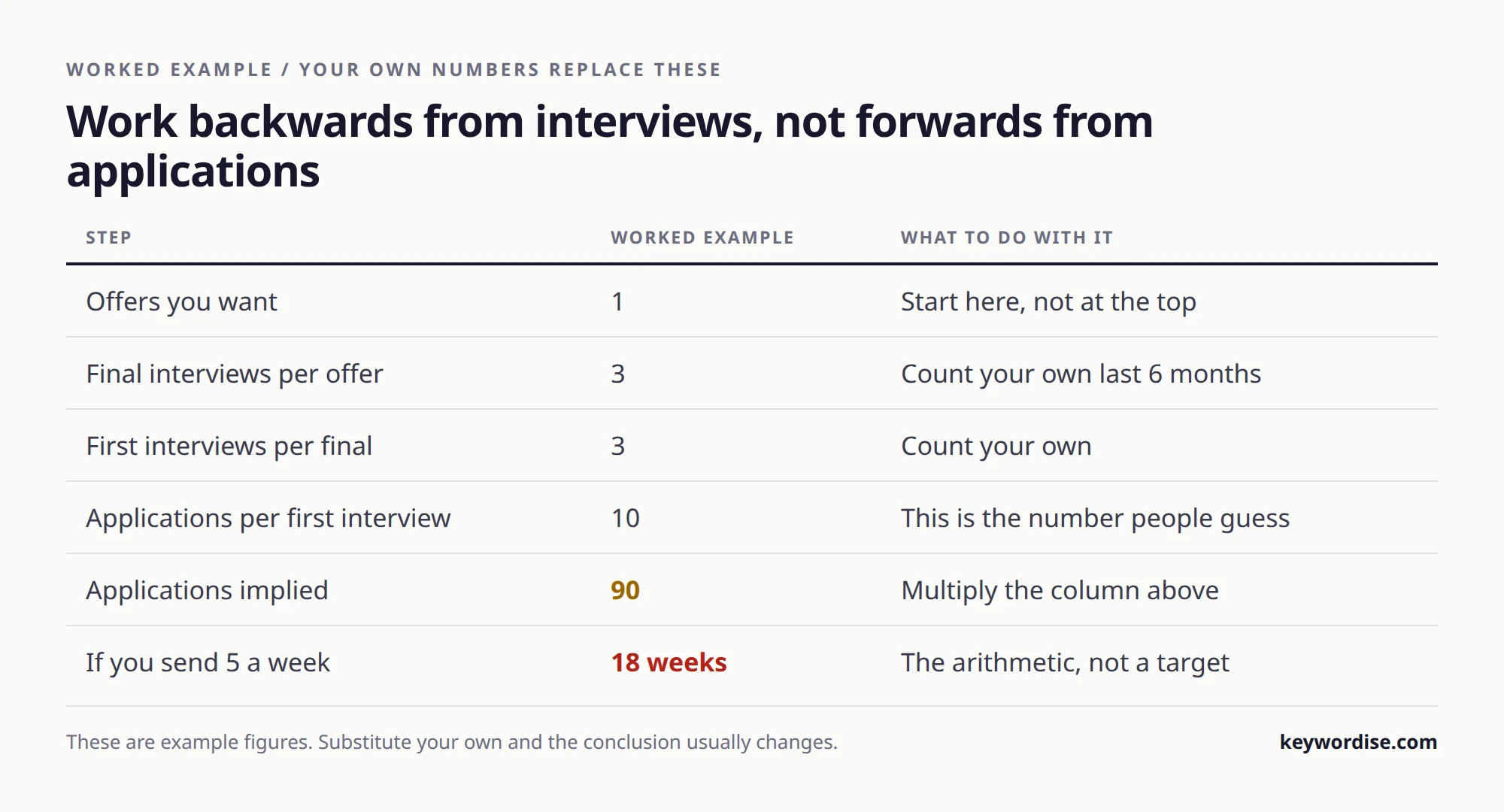
A weekly application target chosen without looking at your own ratios is a number that makes you feel busy. Count backwards from the offer instead and the target picks itself.
The argument in one sentence
Sources
Every source here was fetched and checked before it was linked. Our own parser numbers are reproducible: render the same CV in both layouts and extract it.
Stop sending the same CV
Keywordise writes a fresh, truthful CV for every job and applies for you. 7-day free trial, 27 free applications, no card.
Start free →Frequently asked questions
How many jobs should I apply to per day?
Five genuinely tailored applications is a full session by hand, and ten is the practical ceiling before quality drops. A tailored application takes 20 to 40 minutes, so daily targets above that usually assume no tailoring at all.
How many jobs should I apply to per week?
Between 15 and 30 tailored applications a week is a sustainable pace for most people. Work backwards from interviews instead: if you want three first interviews and your callback rate is 10 percent, that is 30 applications total, not per week.
How many applications does it take to get one interview?
Divide one by your own callback rate. At 2 percent it is about 50 applications, at 5 percent about 20, at 10 percent about 10. Anyone quoting a single universal number is quoting an average of people whose search does not resemble yours.
Is it better to apply to many jobs or few?
Few, well targeted, until you have measured your callback rate. Volume multiplies whatever rate you already have, so raising the rate first makes every later application worth more.
Can I apply to two jobs at the same company?
Yes, if you genuinely fit both and the applications are different. Applying to many roles at one company in a short window is visible in their system and tends to read as untargeted.
How long before I should expect a reply?
Most replies that come at all arrive within two weeks, and silence past four weeks is usually a no. Track the date you applied so you can tell a slow process from a dead one.
Does applying early matter?
Applying within the first few days of a posting helps, because many roles are filled from the first batch of applicants a recruiter reviews. It matters more than the exact number you send.
What if my callback rate stays near zero?
Check parsing before volume. A CV that extracts wrongly is indexed wrongly, and no number of applications fixes that. Paste your PDF into a plain text editor and read what a machine sees.