AI resume builder based on the job description: how it works

Every AI resume tool claims to tailor your CV to the job description. Here is what actually changes underneath, and the test that shows whether a tool is reordering your experience or inventing it.
Every serious AI resume tool now claims to tailor your CV to the job description. Almost none of them explain what they actually change, which makes it impossible to judge whether the output is honest or whether it has quietly invented a skill you do not have.
What tailoring actually changes, field by field
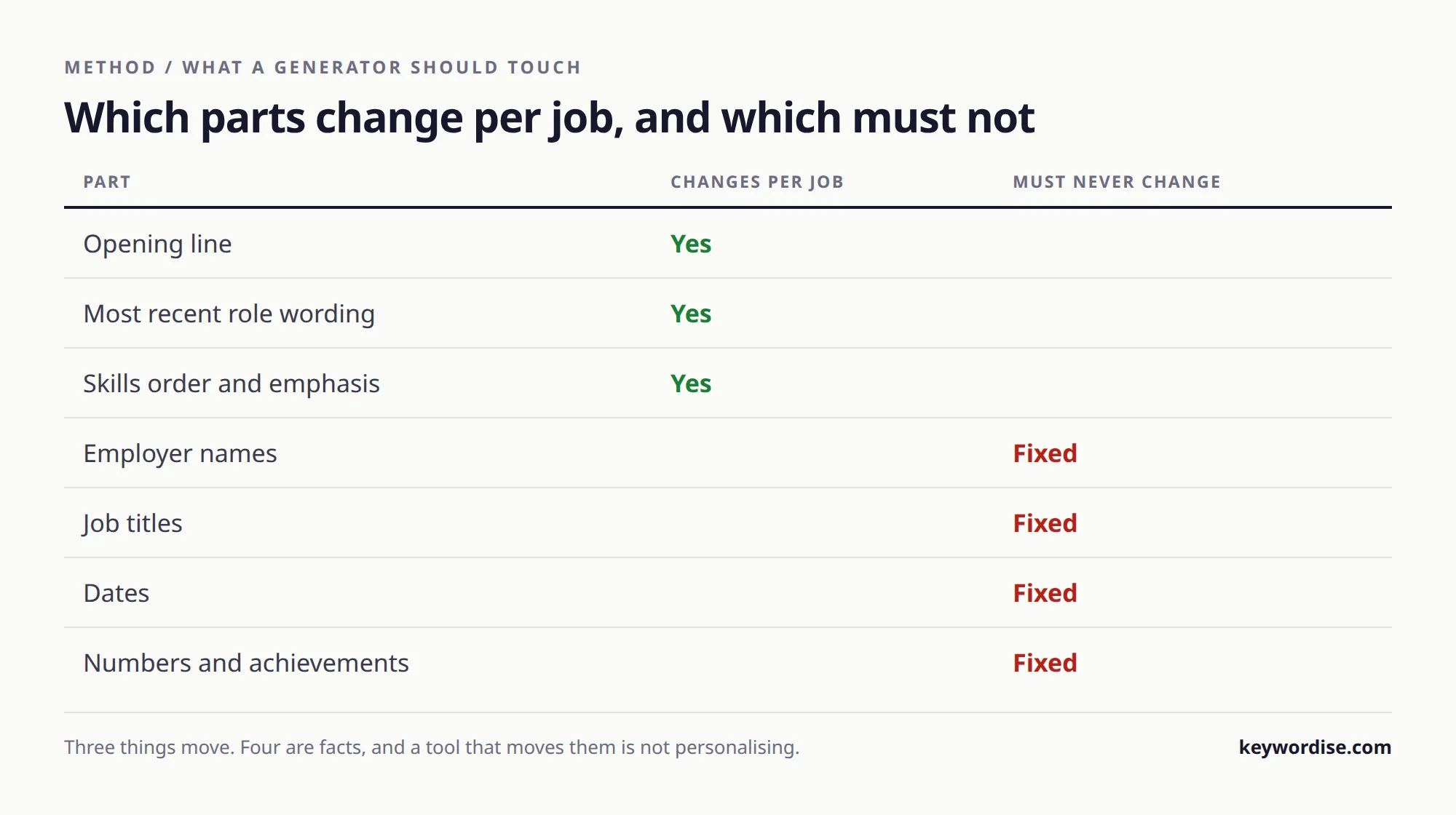
Good tailoring rewrites emphasis and ordering; it never adds experience you do not have. Those are two different operations and only one of them survives an interview.
| Field | What should change | What must not change |
|---|---|---|
| Summary | Rewritten to open with the vacancy's own job title | The seniority you actually held |
| Skills | Reordered so the posting's requirements come first | Tools you have never used |
| Bullets | Emphasis shifted to the relevant outcome | The employer, dates or numbers |
| Job titles | Wording aligned where your real title allows it | A promotion you did not receive |
How the matching works underneath
Modern matching is semantic, not string based: your CV and the posting are both turned into vectors and compared by meaning. That is why "grew revenue" and "drove sales growth" score as related without sharing a word.
- The posting is parsed into requirements, responsibilities and nice-to-haves.
- Your history is embedded the same way, so comparison happens on meaning.
- A weighted pass scores each requirement against your strongest evidence for it.
- Only then does a language model write, and it writes from your own material.
The failure mode nobody advertises
The real risk with an AI resume builder is not a clumsy sentence, it is a confident fabrication. A model asked to match a requirement you do not meet will often satisfy the request rather than refuse it.
Our own rule is that a number may only appear on a CV if the candidate supplied it. Budget and result figures are rendered as visible placeholders until they are filled by hand, because a borrowed number collapses in the interview and takes the true ones down with it.
How to judge an AI resume builder in five minutes
Feed it a job description you are only half qualified for and read what it claims on your behalf. That single test separates the honest tools from the rest.
Does it invent, or does it reorder?
Compare the output against your source CV line by line. Every claim should be traceable to something you wrote. If a tool cannot show you where a sentence came from, treat the sentence as unverified.
Does the output still parse?
A beautifully worded CV in a two-column template is still a two-column template. We measured the same document both ways: 4 out of 9 parser checks against 9 out of 9. Wording and format are separate problems and a tool has to solve both.
Can you still recognise yourself?
If the tone no longer sounds like you, the interview will not match the document. Read it aloud. Anything you would not say out loud should come back out.
Where this fits with the rest
Tailoring only pays off if the file survives the parser first. The order is format, then content, then volume.
- Get the format right first: see what actually parses in 2026.
- Then tailor per posting rather than sending one document everywhere.
- Then decide how many applications the approach is worth: the honest numbers.
- If you would rather not do it by hand, compare the tools that do it for you.
The prompt structure that prevents invention
Order matters: your facts first, the posting second, the prohibition third. A model given the posting before your history will anchor on the posting and fill the gaps from it.
- Paste your real bullets with the numbers already in them.
- Paste the posting underneath, clearly separated.
- State the rule: use only facts above, invent nothing, leave gaps as gaps.
- Ask it to list any sentence it could not source, so omissions become visible.
Three fabrications to look for every time
Models invent in predictable places: scale, seniority and tooling. Those three are also the easiest for an interviewer to test, which is why they are the ones that end processes.
| Fabrication | How it appears | What to do |
|---|---|---|
| Scale | A team size or budget you never gave it | Delete, or replace with the real figure |
| Seniority | led becomes owned, or a title gains senior | Return it to your actual title |
| Tooling | A tool named in the posting, not in your history | Remove it, even if you could learn it |
Sources
Every source here was fetched and checked before it was linked. Our own parser numbers are reproducible: render the same CV in both layouts and extract it.
- Huntr, how applicant tracking systems actually work (1.7M+ applications analysed)
- OneHour Digital, ATS filtering and keyword screening statistics
Stop sending the same CV
Keywordise writes a fresh, truthful CV for every job and applies for you. 7-day free trial, 27 free applications, no card.
Start free →Frequently asked questions
Which AI resume builder works based on the job description?
The useful ones parse the posting into requirements and compare it to your history semantically, then rewrite emphasis and ordering. Ask any tool to show which line of your original CV each rewritten sentence came from. If it cannot, it is generating rather than tailoring.
Can an AI resume builder get me past the ATS?
Only if it also fixes the format. Wording and layout are separate problems: we measured the same CV at 4 out of 9 parser checks in a two-column template and 9 out of 9 in a single column. A tool that rewrites beautifully into a broken template has not helped you.
Is it safe to use AI to write my CV?
Yes for rewriting and reordering what you already did. The risk is fabrication: a model asked to match a requirement you do not meet will often satisfy the request rather than refuse. Read every claim and delete anything you could not defend in an interview.
Will recruiters know my resume was written with AI?
They will notice a document that does not sound like you in the interview, which matters more than detection. Keep your own phrasing, keep your own numbers, and read the result aloud before sending it.
Do I need to tailor my CV for every single application?
Tailor for roles you genuinely want. A tailored CV matches the posting's own vocabulary, which both semantic matching and a human screener respond to. For high-volume applications the honest answer is to automate the tailoring rather than skip it.
What is the difference between an AI resume builder and an AI resume checker?
A builder writes or rewrites the document. A checker reads a finished file back and reports what a parser extracted. They solve opposite halves of the problem and you generally want both.
Does AI tailoring work for non-English CVs?
Yes, and semantic matching is what makes it work: the model compares meaning rather than strings, so a German CV against a German posting behaves the same way. What does not transfer is vocabulary, because each market words the same role differently.
Should the AI add keywords from the job description?
Only where they are true of you, and preferably in your summary and the first bullet of each role, which carry more weight. Copying the posting word for word reads as stuffing and is detected.