Tailoring a resume to a job description: four edits

Everyone says tailor your CV and almost nobody says what that means. In practice it is four specific edits, and everything else is decoration.
Tailoring is the advice everyone gives and almost nobody defines. In practice it means four specific edits, and if you are not making those four, you are reformatting rather than tailoring.
The four edits that count
A tailored CV opens with the vacancy's own job title, leads each role with the requirement that posting cares about most, cuts what it does not ask for, and keeps every number unchanged. Everything else is decoration.
- Open the summary with the posting's exact job title, not your current one.
- Make the first bullet of each role the one that answers this posting.
- Cut skills the posting does not mention rather than appending new ones.
- Leave employers, dates and numbers exactly as they are, always.
Why the first line carries more weight
Keywords in the summary and in the first bullet under each job title are weighted more heavily than the same words further down. That mirrors how a human screener reads: top of section first, then decide whether to continue.
This is why a summary carried over unchanged from the last application is the most expensive shortcut on a CV: it spends the highest weighted position in the document on the wrong job title.
What tailoring cannot fix
If the file does not parse, tailoring the words inside it changes nothing. Format first, content second.
We measured the same CV in two layouts and the two-column version scored 4 out of 9 parser checks against 9 out of 9 single column, with contact details landing inside job entries. Get that right first: the format that parses. Then, if you want the tailoring done per posting without doing it by hand, see how AI tailoring actually works.
A worked example, one role, two versions
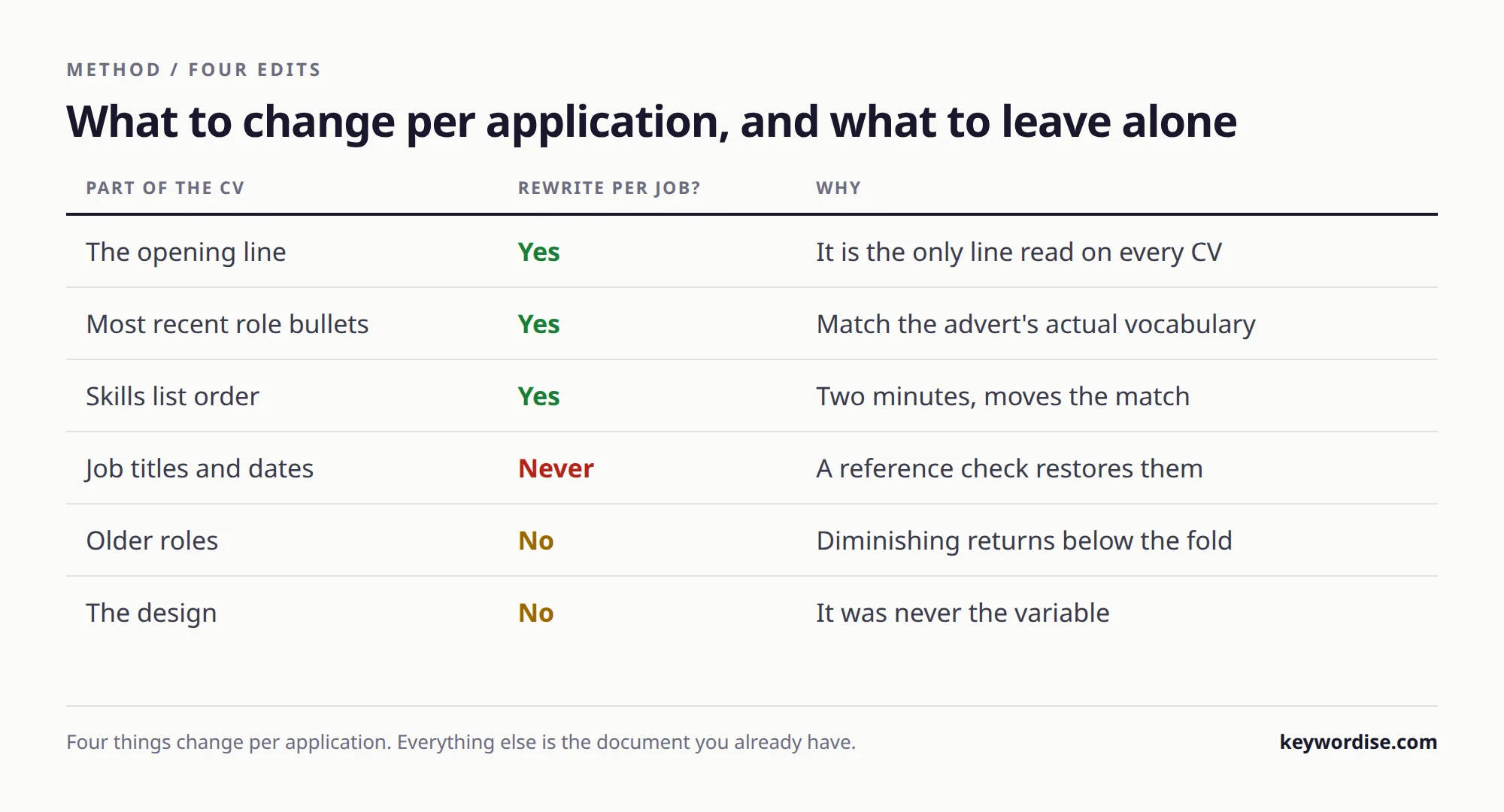
The same job history, pointed at two different postings, differs in about six lines and not a word more. That is what tailoring costs when the base document is doing its job.
- The summary's first clause changes to the posting's job title.
- The first bullet of your most recent role changes to the matching outcome.
- Two or three skills move to the front of the list, none are added.
- One bullet the posting does not care about is cut, not reworded.
Sources
Every source here was fetched and checked before it was linked. Our own parser numbers are reproducible: render the same CV in both layouts and extract it.
- OneHour Digital, ATS filtering and keyword screening statistics
- Huntr, how applicant tracking systems actually work (1.7M+ applications analysed)
Stop sending the same CV
Keywordise writes a fresh, truthful CV for every job and applies for you. 7-day free trial, 27 free applications, no card.
Start free →Frequently asked questions
Does tailoring your resume actually increase callbacks?
It raises the two things that decide a screening: how well the document matches the posting's own vocabulary, and how quickly a human can see the match. The largest single gain usually comes from rewriting the summary to open with the vacancy's exact job title.
What does tailoring a CV actually mean?
Four edits: open the summary with the posting's job title, lead each role with the bullet that answers this posting, cut what the posting does not ask for, and leave every employer, date and number unchanged.
How long should tailoring take per application?
Twenty to forty minutes by hand once you have a strong base CV. If it is taking two hours, the base document is doing too little of the work.
Should I rewrite my job titles to match the posting?
Only within what your real title allows. Aligning wording is fine; awarding yourself a seniority you did not hold is checkable and ends the process when it is found.
Is it better to tailor or to apply to more jobs?
Tailor first, then scale. Volume multiplies whatever callback rate you already have, so raising the rate makes every later application worth more.
Do I need a different CV for every job?
A different summary and a different first bullet per role, yes. A completely rewritten document, no. Most of the file stays the same and should.
Can I tailor a CV without lying?
Yes, and that is the whole discipline. Tailoring changes emphasis and ordering. Anything that changes the facts is not tailoring.
Does tailoring matter if a company uses an ATS?
More, not less. Modern systems match meaning, so a CV that reflects the posting's actual responsibilities ranks better for that posting than a generic one does.