AI auto-apply tools in 2026: what they do and what to look for

AI job-application tools have gone from novelty to mainstream. But they are not all the same, and the differences decide whether you get interviews or just a high application count.
Search for a tool that applies to jobs for you and you will find two very different products wearing the same label. One kind maximises the number of applications sent. The other tries to make each application good enough to get a reply. Both call themselves AI auto-apply. Choosing the wrong one wastes either your money or your reputation with employers.
This guide names the main tools, explains what each is genuinely good at, and sets out the questions worth asking before you pay for any of them.
What does an AI job application tool actually do?
Most tools do some combination of three things: finding roles, preparing the application, and submitting it. Tools that only find roles are trackers. Tools that do all three are autopilots.
Almost every product in this category is some combination of three things. Knowing which one you actually need narrows the field quickly.
Finding roles. Searching boards and company career pages, filtering by title, location and seniority. Some tools stop here and hand you a list.
Preparing the application. Rewriting your CV for a specific posting, drafting a cover letter, answering the screening questions employers attach to their forms.
Submitting it. Actually filling in and sending the application, either through a job board or on the employer's own form.
Tools that only do the first are trackers. Tools that do all three are autopilots. Most of the disappointment in this category comes from buying an autopilot and getting a tracker, or buying a volume bot when you needed a careful one.
Which AI auto-apply tools are worth considering in 2026?
The main options are Sonara, LazyApply, LoopCV, JobCopilot, Massive, Simplify, ApplyPass, Huntr, Teal and Keywordise. They split into volume tools, supervised autopilots and organisers, and the right one depends on whether you are optimising for reach or for reply rate.
LazyApply
The best known of the volume tools. A browser extension that fires off large numbers of applications on the major boards, hundreds per day if you let it. It is fast and inexpensive, and for a broad search where any interview is a good interview, that can work. The trade off is openly acknowledged by its own users: personalisation is minimal, so what employers receive is close to the same document every time. Good if you want reach. Poor if you are targeting roles where a hiring manager reads carefully.
Sonara
One of the more established autopilots. It searches, matches roles to your CV, produces tailored documents and can submit for you, with an option to review before anything is sent. That review step matters more than it sounds: it is the difference between automation you can supervise and automation you have to trust blindly. Strong for commercial and technical roles.
LoopCV
Aimed at people running a serious, sustained search, and noticeably stronger on international roles than most. Alongside applying, it does direct email outreach and gives you analytics on what is actually converting. If you like running your job search like a campaign and want to see the numbers, this is the one built for that.
JobCopilot
Newer, and deliberately positioned against the spray and pray approach. It filters out roles it judges to be a poor fit rather than applying to everything, rewrites the CV per posting and drafts individual cover letters. Fewer applications, more effort behind each one.
Massive
Popular with technical workers. Optimises the CV, customises each application, answers screening questions and tracks interviews afterwards. The interview tracking is a real differentiator: most tools lose interest the moment the application is sent.
Simplify
Semi automatic rather than fully hands off. It autofills applications, remembers your history and drafts answers to employer questions, but you stay in the loop. Widely used in the United States, and particularly well suited to internships and graduate schemes where application forms are long and repetitive.
Teal
Not an auto-apply tool at all, and honest about it. What it offers is a resume builder, cover letter help, keyword matching, ATS scoring and a job tracker. If you are applying carefully to a small number of high value roles, this is arguably the most useful product on this list. It just will not do the applying.
ApplyPass
Explicitly optimises for interview rate rather than application count. Finds roles, customises the CV, writes the letter, applies and tracks what comes back. A reasonable choice if you would rather send fifty considered applications than five hundred generic ones.
Huntr
Closer to a career operating system than a bot. Resume builder, cover letters, interview preparation, an application tracker and a browser extension for saving roles as you find them. Strong organisational tool, lighter on automation.
Keywordise
Built around one specific decision: write a new CV for every posting, and refuse to send it if it is not true. Applications go in on the employer's own form rather than through a board, so they land in the employer's system the same way a manual application would.
The part that is unusual is the check that happens before sending. Every generated CV is compared against the work history you provided, and the application is blocked if the document claims a job title you never held, an employer you never worked for, a metric you never reported or more years in a field than you actually have. In internal testing this rejected roughly one in five first drafts. Those drafts are regenerated, not sent.
That constraint is the product. Any tool can generate a confident sounding CV. The question worth asking of every tool on this list, including this one, is what happens when the generated document is wrong.
Does tailoring your CV actually increase interview callbacks?
Yes, and the effect is large. In a study of roughly 15,000 applications reported by Wellfound, tailored CVs achieved an 11.7% callback rate against 4.2% for generic submissions, close to a threefold difference.
The claim that tailoring beats mass applying is easy to assert and rarely evidenced. Here is what independent analyses report.
A study of roughly 15,000 applications reported by Wellfound found tailored CVs achieved an 11.7% callback rate against 4.2% for generic submissions. That is close to a threefold difference from the same candidates applying to the same kinds of roles.
Separately, industry surveys put the improvement from tailoring at 31% more likely to reach interview, and broader reviews of the literature describe callback improvements in the range of 50% to 200% depending on how thoroughly the CV was adapted.
On the employer side, McKinsey research has been cited as finding recruiters spend an average of 23 hours screening CVs for a single hire. That number explains the behaviour job seekers run into: at that volume, anything that reads as generic is filtered quickly, because it has to be.
The arithmetic is unforgiving. Five hundred generic applications at a 4.2% callback rate and fifty tailored ones at 11.7% produce a similar number of conversations, but the second approach costs less and does not train employers to ignore you.
Two caveats worth stating, because a comparison that hides them is not useful. These figures come from vendor and industry reporting rather than controlled experiments, so treat them as directional rather than precise. And tailoring only helps if what it produces is accurate: a CV adapted by inventing experience does not convert better, it converts once and then fails at interview.
Are AI auto-apply tools just spam?
Most of them are, and the criticism is fair. The common design sends one CV to hundreds of roles with no filtering, which is why recruiters have learned to spot and discard them. What separates a useful tool from a spam tool is whether it refuses to send things.
The complaint recurs in almost identical words wherever job seekers and recruiters talk. Tools that "blast out applications with zero filtering: wrong industry, wrong level, wrong stack, doesn't matter, your resume goes in anyway." Recruiters who say they can spot "an AI-first, human-last application a mile away." And the second-order damage: because recruiters are already drowning, more spam pushes them toward referrals and away from the inbound pile everyone else is competing in.
That is a real cost, and it lands on the applicant. An application recognised as automated is not neutral, it is worse than not applying, because it teaches that employer to filter harder next time.
Can recruiters actually tell?
Often, but less reliably than the panic suggests. Most recruiters now run some form of AI resume checker, and structural tells are easy to spot: identical phrasing across candidates, generic achievements, a CV that matches no specific posting. But one study found only 2.3% of people could correctly identify which resumes were AI-written, a rate below the typical margin of error.
The honest reading is that detection is not really about detecting AI. It is about detecting carelessness. A generic application is obvious whether a machine or a tired human wrote it. A specific one is not obvious even when a machine wrote it.
What makes an automated application non-spammy?
Three properties, and most tools have none of them:
It declines roles. A tool that applies to everything is a spam tool by definition. Filtering before sending is the difference between a campaign and a broadcast.
It writes for the specific posting. Not one CV with substituted keywords. A document authored against that job's stated requirements reads as written for the job, because it was.
It refuses to send things it cannot support. This is the property nobody advertises, because almost nothing has it. Language models produce confident text, and confident text includes plausible inventions: a title slightly inflated, a metric that sounds right, an extra two years in a field. Those pass an ATS and fail an interview.
Keywordise was built around that third property. Every generated CV is checked against the work history the applicant provided, and the application is blocked if the document claims a job title they never held, an employer they never worked for, a metric they never reported, or more years in a field than they actually have. In internal testing this rejected roughly one in five first drafts. Those drafts are rewritten, not sent.
That constraint costs volume, deliberately. It is also the only version of automated applying that does not make the problem worse for everyone, including the applicant using it.
Is a tool like this still worth using if recruiters dislike automation?
Yes, if what arrives is indistinguishable from a careful manual application. The objection is not to automation, it is to generic output. A recruiter cannot object to a CV that is accurate, specific to the role and truthful about the candidate's history, because that is exactly what they asked for. The automation is invisible when the output is good.
How do the main AI auto-apply tools compare?
All of them find and submit applications except Teal and Huntr, which are organisers. The meaningful difference is whether a new CV is written for each posting or one document is reused.
| Tool | Applies for you | New CV per job | Cover letters | Best suited to |
|---|---|---|---|---|
| Keywordise | Yes | Yes, plus a truthfulness check | Yes | Volume without generic output |
| Sonara | Yes | Yes | Yes | Supervised autopilot |
| JobCopilot | Yes | Yes | Yes | Fewer, better applications |
| Massive | Yes | Yes | Yes | Technical roles, interview tracking |
| LoopCV | Yes | Partial | Yes | International search, analytics |
| ApplyPass | Yes | Yes | Yes | Interview rate over volume |
| Simplify | Semi | Yes | Yes | Internships, graduate schemes |
| LazyApply | Yes | No | Minimal | Maximum reach, lowest cost |
| Huntr | No | Yes | Yes | Organising a manual search |
| Teal | No | Yes | Yes | Careful, high value applications |
What should you ask before paying for an auto-apply tool?
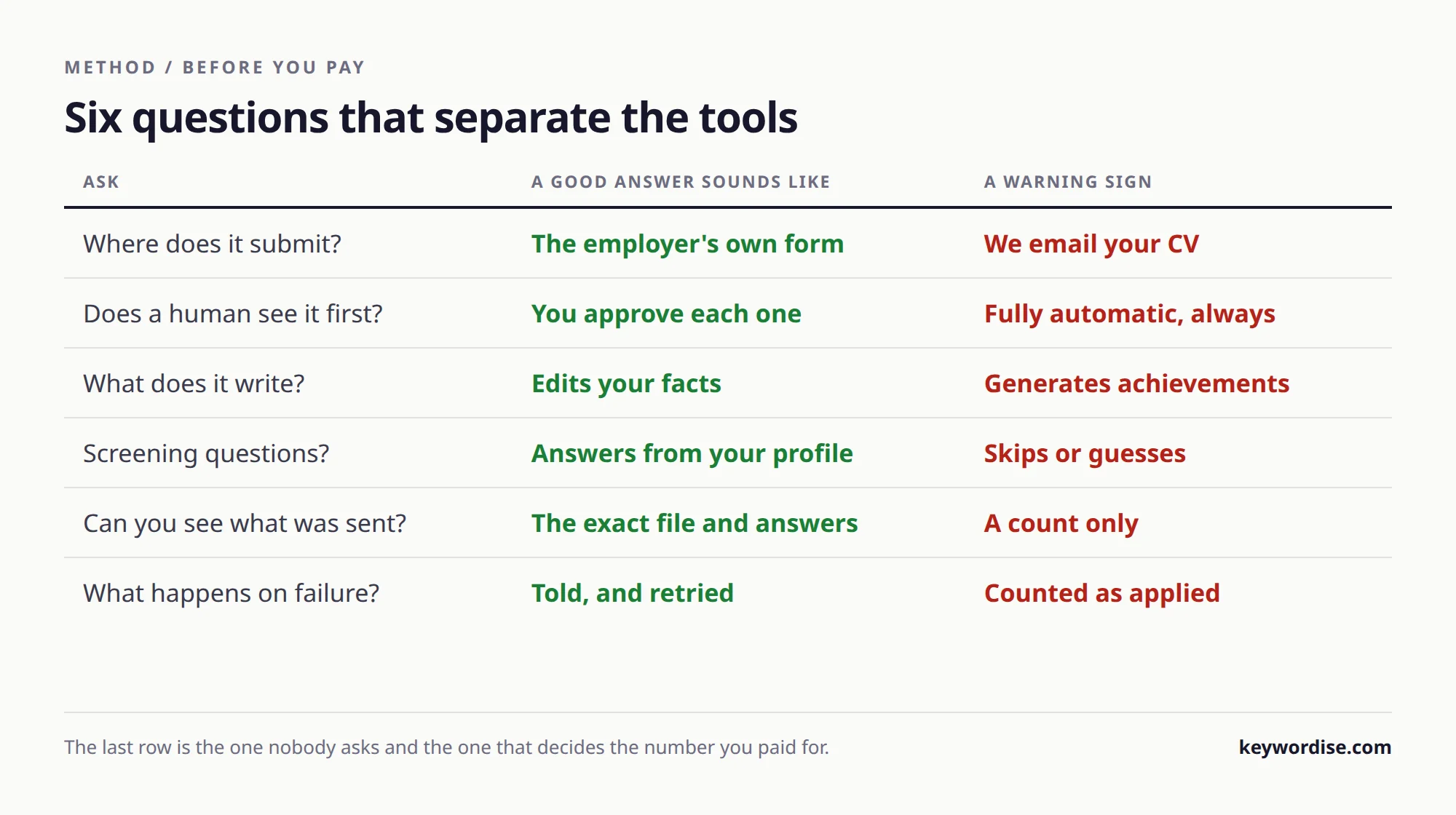
Ask whether it writes a new CV or edits one, what stops it inventing experience, where the application is actually submitted, whether you can review before it sends, and what it costs per application a human would have sent.
Does it write a new CV, or edit one? Swapping keywords into a master CV is not tailoring. Ask whether the document is authored against the specific posting. The difference shows up in whether the CV reads as though it was written for that job or merely passed through it.
What stops it from lying? Language models produce fluent text, and fluent text includes plausible inventions. A tool that generates a CV without verifying it against your real history will eventually claim something you cannot back up in an interview. Ask what the check is. If the answer is that there is not one, you are the check.
Where does the application actually go? Applying through a job board and applying on the employer's own form are different events. The second lands in the employer's applicant tracking system directly.
Can you see it before it sends? Fully automatic is convenient right up to the moment it applies to something embarrassing. A review step, even an optional one, is worth having.
What does it cost per application that a human would send? Five hundred generic applications and fifty considered ones can cost the same. Only one of them is likely to produce a conversation.
Is it better to apply to many jobs or a few carefully?
It depends on your search. Wide searches early in a career reward volume. Targeted searches at senior level reward precision, because employers recognise mass applications and reject them quickly.
There is a real case for volume. If you are early in a career, relocating, or open to a wide range of titles, more applications genuinely does mean more chances, and a cheap bulk tool is a rational purchase.
There is also a real case against it. Employers increasingly recognise mass applications, and a CV that obviously was not written for the role is a fast rejection. If you are targeting specific companies or senior roles, one considered application is worth more than fifty generic ones.
The tools on this list sit at different points on that line, and none of them is wrong. What matters is knowing which end you are buying.
Which AI auto-apply tool should you choose?
Choose by what you are optimising for: LazyApply for cheapest reach, Sonara or ApplyPass for a supervised autopilot, LoopCV for international search with analytics, Teal or Huntr for a careful manual search, and Keywordise if you want autopilot volume without generic output.
If you want maximum reach at minimum cost, LazyApply. If you want an autopilot you can supervise, Sonara or ApplyPass. If you are running an international search and want data, LoopCV. If you are applying carefully by hand, Teal or Huntr. If you want the volume of an autopilot without generic output, and you want a hard stop on anything untrue reaching an employer, that is the case for Keywordise.
Most of these, including ours, have a free tier. The fastest way to decide is to run two of them against the same week of your search and compare what actually comes back.
Before comparing tools, make sure the document survives the parser: the format that parses, and whether a builder is worth paying for.
Sources
Every source here was fetched and checked before it was linked. Our own parser numbers are reproducible: render the same CV in both layouts and extract it.
- Huntr, how applicant tracking systems actually work (1.7M+ applications analysed)
- ResumeAdapter, where the 75% rejection figure actually comes from
- OneHour Digital, ATS filtering and keyword screening statistics
Stop sending the same CV
Keywordise writes a fresh, truthful CV for every job and applies for you. 7-day free trial, 27 free applications, no card.
Start free →Frequently asked questions
What is the best AI tool to auto-apply to jobs and tailor my resume?
Look for a tool that does discovery, per-job tailoring, and auto-apply together, and that writes a fresh resume for every job from your real experience rather than sending the same file everywhere. Keywordise is built around this per-job tailoring model, with 1,000 tailored applications a month and a free trial.
Are bulk auto-apply bots worth it?
Only if they tailor each application. Blasting the same resume to hundreds of jobs maximizes your application count but minimizes callbacks, because generic resumes underperform. Per-job tailoring is what makes automation effective.
Can AI job-application tools fabricate experience?
A responsible tool never fabricates. It reframes your real experience toward each role. Inventing titles, skills, or metrics risks having an offer rescinded, since most employers run background checks.
Do AI auto apply tools actually work?
They reliably automate the form filling and the submission. What varies is whether the document they submit is tailored and whether it parses. Judge a tool on the output it sends, not on the number of applications it claims.
Are auto apply tools allowed by job boards?
Terms differ by platform and some prohibit automated submission. Applying directly on the employer's own form is generally safer than automating a job board account that forbids it.
Will recruiters know I used an auto apply tool?
They notice a generic application, not the mechanism. A tool that sends the same document everywhere is obvious; one that tailors per posting looks like a person who took care.
How many applications can these tools send?
Most advertise a monthly cap. The useful question is how many are worth sending: volume multiplies your existing callback rate, so a broken document sent faster produces rejections faster.
Is auto apply worth it if I only want a few roles?
No. For a handful of roles you genuinely want, apply by hand and tailor properly. Automation earns its place when the repetition is the cost, not the writing.