Explaining a gap in your CV without hiding it

A gap is what most applicants try hardest to hide, and hiding it is what turns a non-issue into a problem. Recruiters expect gaps; they do not expect a timeline that does not add up.
A gap in a CV is a question, not a verdict. It becomes a verdict only when the document leaves it unanswered, because a reader who finds no explanation supplies one, and the one they supply is rarely generous.
One line, in the timeline, where the gap is
Put the explanation where the gap is, as an entry with its own dates, not in the cover letter and not in a footnote. The reader is scanning a timeline. An entry closes the question at the moment it is asked; anywhere else, the question has already been answered by their imagination.
What the line should say
Name the reason in three or four words, then say what you did with the time if there is something honest to say. Do not apologise, do not explain at length, and do not invent a consultancy that existed only on paper. A short, flat statement is read as confidence; a paragraph is read as defensiveness.
| The reason | Write it as | Add if true |
|---|---|---|
| Redundancy | Role made redundant, site closure | Certification, contract work, volunteering |
| Caring for family | Full-time care for a family member | Any freelance or study kept up alongside |
| Illness or recovery | Medical leave, now fully recovered | Nothing else is required, and nothing more is owed |
| Study or retraining | Full-time study, name the qualification | The completion date, or expected completion |
| Travel | Extended travel, name the region | Language learned, work done abroad |
| A long search | Job search after role ended | Courses, projects, contract work taken |
A gap you have named is a fact. A gap you have left blank is whatever the reader is willing to imagine, and you are not in the room to correct them.
Why the line goes in the timeline
The two repairs that make it worse
Both of the popular fixes are worse than the gap. Years-only dates hide a three-month gap and create a twelve-month question, and every reader knows what they are for. An invented freelance period is a fact that a reference check turns into a different conversation entirely.
- Years-only dates: every reader reads them as concealment, including when they are not.
- An invented consultancy: it survives the CV and not the reference check.
- Stretching the previous role to cover the gap: this is the one that ends offers.
- A functional CV with no dates at all: it reads as a gap everywhere rather than in one place.
- Explaining at length in the cover letter: it arrives after the question was already answered.
What the software does with the dates
An entry with a start and end date parses as employment history; a sentence in a cover letter does not parse at all. That is the practical argument for the timeline entry: the explanation is stored in the same field as everything else, in the right order, and survives into the database a recruiter later searches. Keep the dates in one consistent format, MM.YYYY throughout.
Sources
Every source here was fetched and checked before it was linked.
- Acas, what an employer may and may not ask about
- National Careers Service, how a CV is structured
- Huntr, how applicant tracking systems read employment dates
Stop sending the same CV
Keywordise writes a fresh, truthful CV for every job and applies for you. 7-day free trial, 27 free applications, no card.
Start free →Frequently asked questions
How do I explain a gap in my CV?
Put one line in the timeline where the gap is, with its own dates, naming the reason in three or four words. Add what you did with the time only if there is something honest to add.
How long does a gap have to be before it needs explaining?
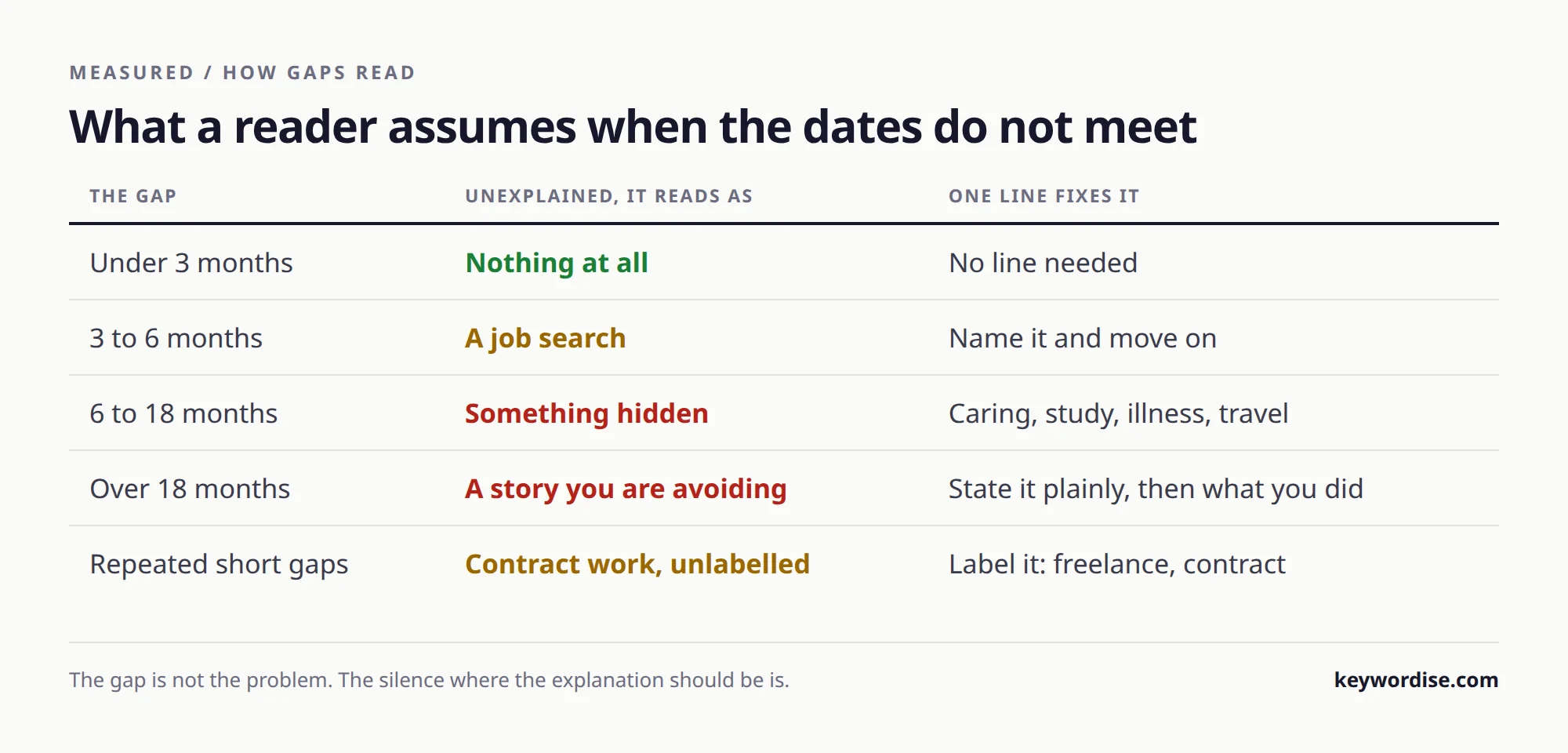
Under three months, nobody looks. Three to six reads as a job search and one line settles it. Beyond six months, an unexplained gap starts to read as something being hidden.
Should I use years only to hide a gap?
No. Years-only dates are read as concealment by every experienced reader, and they turn a three-month gap into a twelve-month question.
Can I say I was freelancing?
Only if you were. An invented freelance period survives the CV and not the reference check, and being caught converts a small gap into a question about honesty.
Do I have to say I was ill?
No. Medical leave, now fully recovered is enough, and you owe no detail beyond that. An employer asking for more is on difficult ground.
Where does the explanation go, CV or cover letter?
The CV, in the timeline. A reader scanning dates meets the gap there, and an explanation in the letter arrives after they have already supplied their own.
Does a career break hurt more than a short gap?
Not if it is named. A stated two-year break for caring or study reads as a decision. The same two years left blank reads as a story being avoided.
Do applicant tracking systems flag gaps?
They store start and end dates, so a gap is visible in the parsed record whether or not anyone flags it. An entry with dates is stored as employment history; a sentence in a cover letter is not parsed at all.