AI cover letter that does not sound like AI: the four tells

A generated cover letter is easy to spot and easy to fix. The tells are the same across every model, and the edit takes about four minutes.
A generated cover letter is easy to spot and easy to fix. The tells are consistent across every model, and once you know them the edit takes about four minutes.
The tells, and what to do about each
The giveaway is never a single word, it is a shape: an opening about passion, a middle that restates the posting, and a close that thanks them for their time.
| Tell | Why it appears | The fix |
|---|---|---|
| "I am passionate about" | Default opener in every model | Open with why you are writing this week |
| The posting repeated back | The model was given it as context | Replace with one thing you did that proves it |
| Em dashes and tricolons | Trained-in prose rhythm | Plain commas and full stops |
| No specific number anywhere | The model has none of your facts | Add one real figure only you could know |
Use the model for structure, not for content
A language model is good at arrangement and bad at knowing what you did, so give it the facts and let it order them. The reverse, asking it to invent substance from a job title, is where generated letters go wrong.
- Give it three things you actually did, with the numbers attached.
- Give it the posting and ask which of the three answers it best.
- Ask for four sentences, not four paragraphs.
- Rewrite the first sentence yourself, always. It is the only one read closely.
Does a cover letter still matter?
It matters where it is read, and it is read far less often than the CV. Spend the effort in proportion: the CV is parsed and searched, the letter is skimmed by one person if at all. Get the CV right first, in the format that parses.
The four-sentence structure that works
Why this role, the one proof, the one thing the CV cannot show, and what you want to happen next. That is the whole letter, and anything longer is usually the CV repeated.
| Sentence | Job | Common mistake |
|---|---|---|
| 1 | Name the role and why it, specifically | Opening with how pleased you are |
| 2 | One proof, with a number | Three proofs, none memorable |
| 3 | The thing the CV cannot carry | Repeating a bullet verbatim |
| 4 | What you want to happen | Thanking them for their time |
When to skip the letter entirely
If you cannot name something the CV does not already say, the letter subtracts. A weak optional letter is worse than none, because it spends the reader's attention on repetition.
- Write one for a career change, a gap, or a specific reason for this employer.
- Write one when the posting names a person you can address.
- Skip it when it is optional and you would only be restating the CV.
- Never write one longer than the screen it is read on.
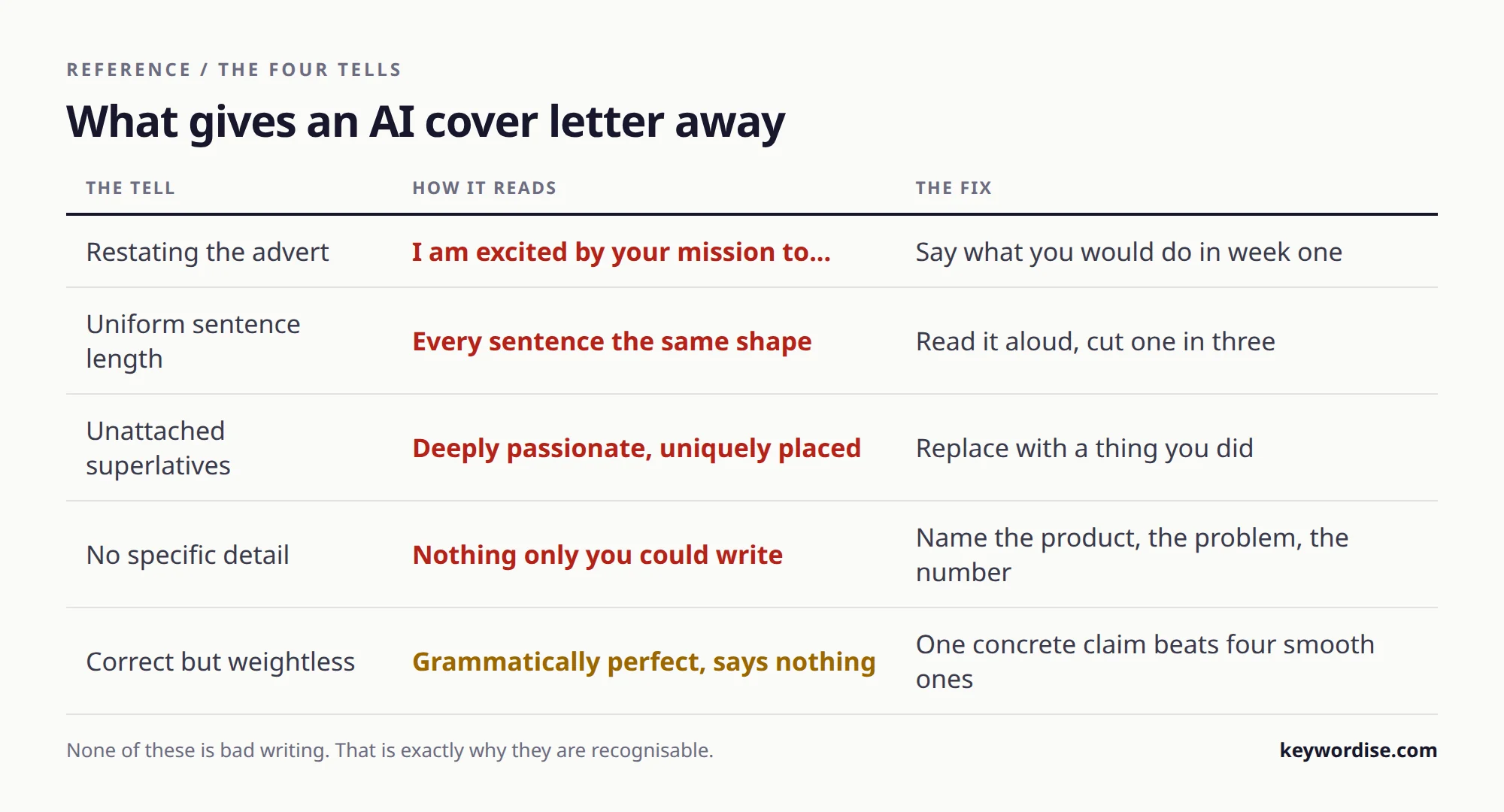
A generated letter is not caught because it is badly written. It is caught because it is smoothly written about nothing that only you could have said.
What recruiters are actually noticing
Sources
Every source here was fetched and checked before it was linked. Our own parser numbers are reproducible: render the same CV in both layouts and extract it.
- SelectSoftwareReviews, applicant tracking system statistics
- Huntr, how applicant tracking systems actually work (1.7M+ applications analysed)
Stop sending the same CV
Keywordise writes a fresh, truthful CV for every job and applies for you. 7-day free trial, 27 free applications, no card.
Start free →Frequently asked questions
What is the best AI cover letter generator?
The best result comes from any capable model given three real things you did with the numbers attached, asked for four sentences. Tools differ less than inputs do: a generator with no facts about you produces the same generic letter regardless of brand.
How do I make an AI cover letter not sound like AI?
Rewrite the first sentence yourself, delete any opening about passion, remove the paragraph that restates the posting, and add one number only you could know. Four minutes of editing removes almost every tell.
Can employers detect an AI written cover letter?
Detection tools are unreliable, but humans notice the shape: passion opener, posting restated, thanks for your time. That pattern reads as generated whether or not anything flags it.
Should a cover letter be one page?
Far shorter. Four to six sentences is enough for the only job a letter does, which is to say why this role and what you bring that the CV does not already show.
Do I need a cover letter if it is optional?
Write one when you have something the CV cannot carry: a career change, a gap, a specific reason for this employer. If you have none of those, the letter adds nothing and a weak one can subtract.
Does the ATS read my cover letter?
It is usually stored and searchable but weighted far below the CV, and many recruiters never open it. Treat it as a message to a person, not as a second keyword surface.
Should the cover letter repeat my CV?
No. Repetition is the most common weakness. The letter should add the reasoning the CV cannot: why this role, why now, why you.
What should the first sentence say?
Something only true of this application. Name the role, and give the one fact about you that makes the rest worth reading. Never open with how pleased you are to apply.