Applying after being let go: what to say and where

Being let go is common, and saying so plainly costs far less than the phrasing most people reach for instead.
Being let go is common enough that no reader is shocked by it. What they react to is the wording, because the wording is the only evidence they have about whether the ending was about the role or about you.
Redundancy and dismissal are not the same word
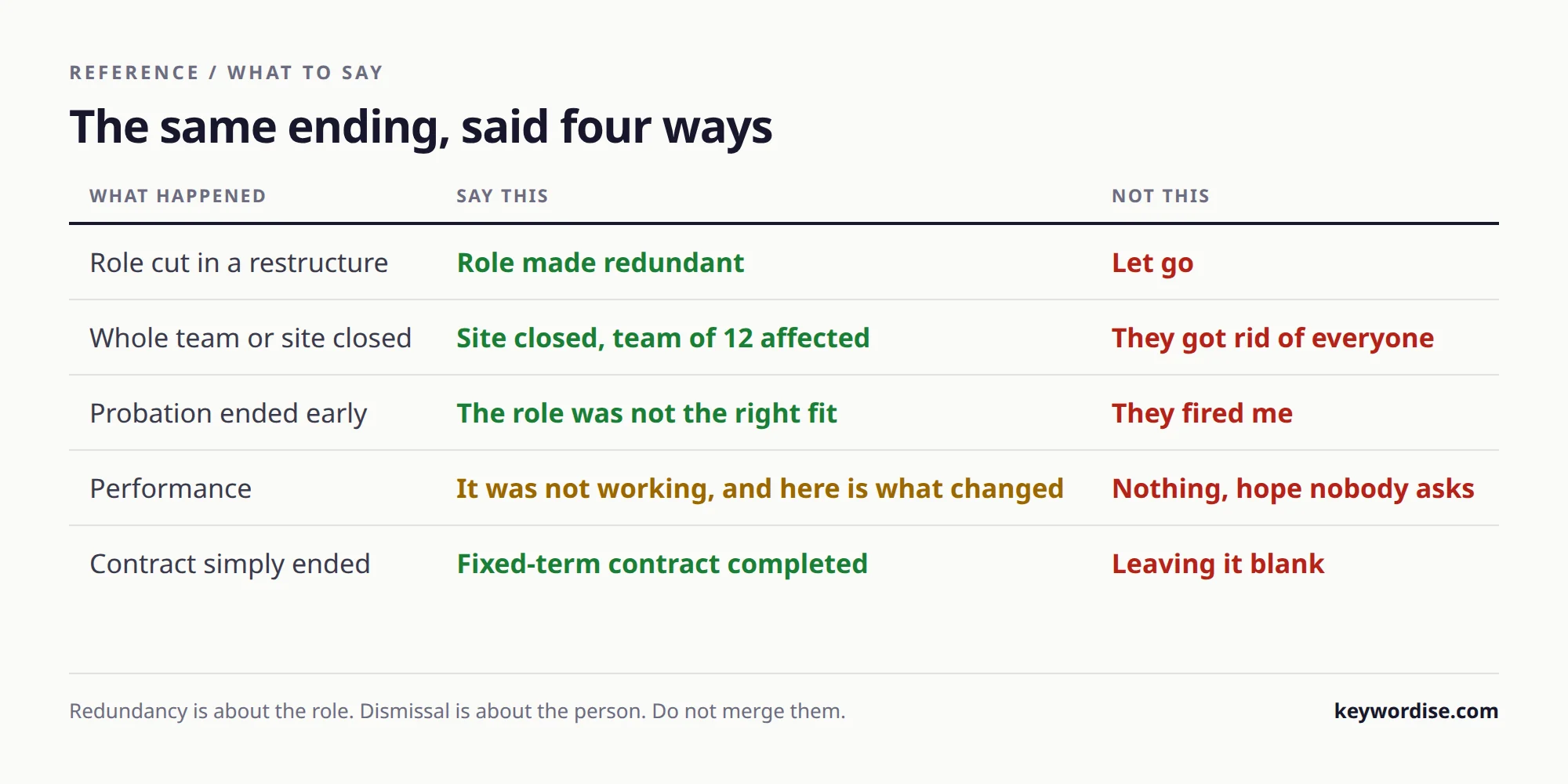
Redundancy is a decision about a role. Dismissal is a decision about a person. If your role was cut, say made redundant, which is the word the whole market understands and carries no judgement about you. Let go is vague, and a vague phrase in this particular place is read as the worse of the two possibilities.
Where it belongs, and where it does not
The CV carries the dates and nothing more. A CV does not explain why a job ended, and adding a reason to an entry draws attention to the one line you wanted read normally. The explanation belongs in the interview, and in the cover letter only when the gap that followed needs a line.
| Document | What it should carry | What it should not |
|---|---|---|
| CV | Dates, employer, title, what you did | Any reason for leaving, on any entry |
| Cover letter | One line only if the gap needs one | The full account, or anything defensive |
| Interview | Two sentences, then what you did next | Blame, detail about colleagues, litigation |
| Application form | Redundancy where the form asks directly | A softened word that a reference will contradict |
Two sentences and a forward step. The interviewer is not testing whether it was your fault; they are testing whether you can talk about it without the room getting heavy.
What the question is actually for
The two sentences, in the interview
Say what happened, say it in the past tense, and end on what you did next. Then stop talking. The most common mistake is not the answer but its length: an explanation that keeps going tells the room the speaker has not finished processing it.
- My role was made redundant when the team was restructured in March.
- The site closed and twelve of us were affected.
- It was a fixed-term contract and it completed.
- It was not the right fit, and I learned what I would check before accepting next time.
- Then, in every case: since then I have been doing X, and that is why this role.
The gap that follows is the real task
In practice the ending is rarely the problem; the months after it are. A gap under three months needs nothing. Past six months, put one line in the timeline where the gap is, with its own dates, rather than leaving the reader to fill it in. An entry with dates parses as employment history and reaches the database; a sentence in a letter does not parse at all. See explaining a gap without hiding it.
Sources
Every source here was fetched and checked before it was linked. The employment law references are UK; the wording advice applies wherever you are applying.
- Acas, what redundancy is and how it differs from dismissal
- GOV.UK, redundancy and your rights
- National Careers Service, how a CV is structured
- Huntr, how applicant tracking systems read employment dates
Stop sending the same CV
Keywordise writes a fresh, truthful CV for every job and applies for you. 7-day free trial, 27 free applications, no card.
Start free →Frequently asked questions
Should I put on my CV that I was made redundant?
No. A CV carries dates, employer, title and what you did. Adding a reason for leaving draws attention to the one line you wanted read normally. Save it for the interview.
What is the difference between redundancy and being fired?
Redundancy is a decision about a role that no longer exists. Dismissal is a decision about a person. They are different events and using the wrong word for yours costs you interviews.
How do I explain being let go in an interview?
Two sentences in the past tense, then what you did next, then stop. The length of the answer says more than its content: an explanation that keeps going sounds unfinished.
Do I have to tell them I was dismissed?
Answer honestly what you are directly asked, especially on an application form a reference may later contradict. You are not required to volunteer it unprompted on a CV.
Will a gap after redundancy hurt my application?
Under three months, no one looks. Past six months an unexplained gap starts to read as something hidden, so put one line with its own dates in the timeline where the gap is.
Should I say let go or made redundant?
Made redundant, when that is what happened. Let go is vague, and in this particular place a vague phrase is read as the worse of the two possibilities.
What if I was dismissed for performance?
Say plainly that it was not working, then what you changed as a result. An answer that names a change lands very differently from one that assigns blame.
Does an ATS know I was made redundant?
No. It stores start and end dates, so it sees when a job ended and not why. The gap that follows is visible in the parsed record; the reason never was.