ATS resume checker and the ATS score that does not exist

Thousands of people a month look for a tool that reports their ATS score. The number those tools return is their own invention, and the useful thing they do is something else.
Thousands of people a month search for a tool that will tell them their ATS score. The uncomfortable answer is that the number those tools return is their own invention, and the useful thing they do is something else entirely.
There is no universal ATS score
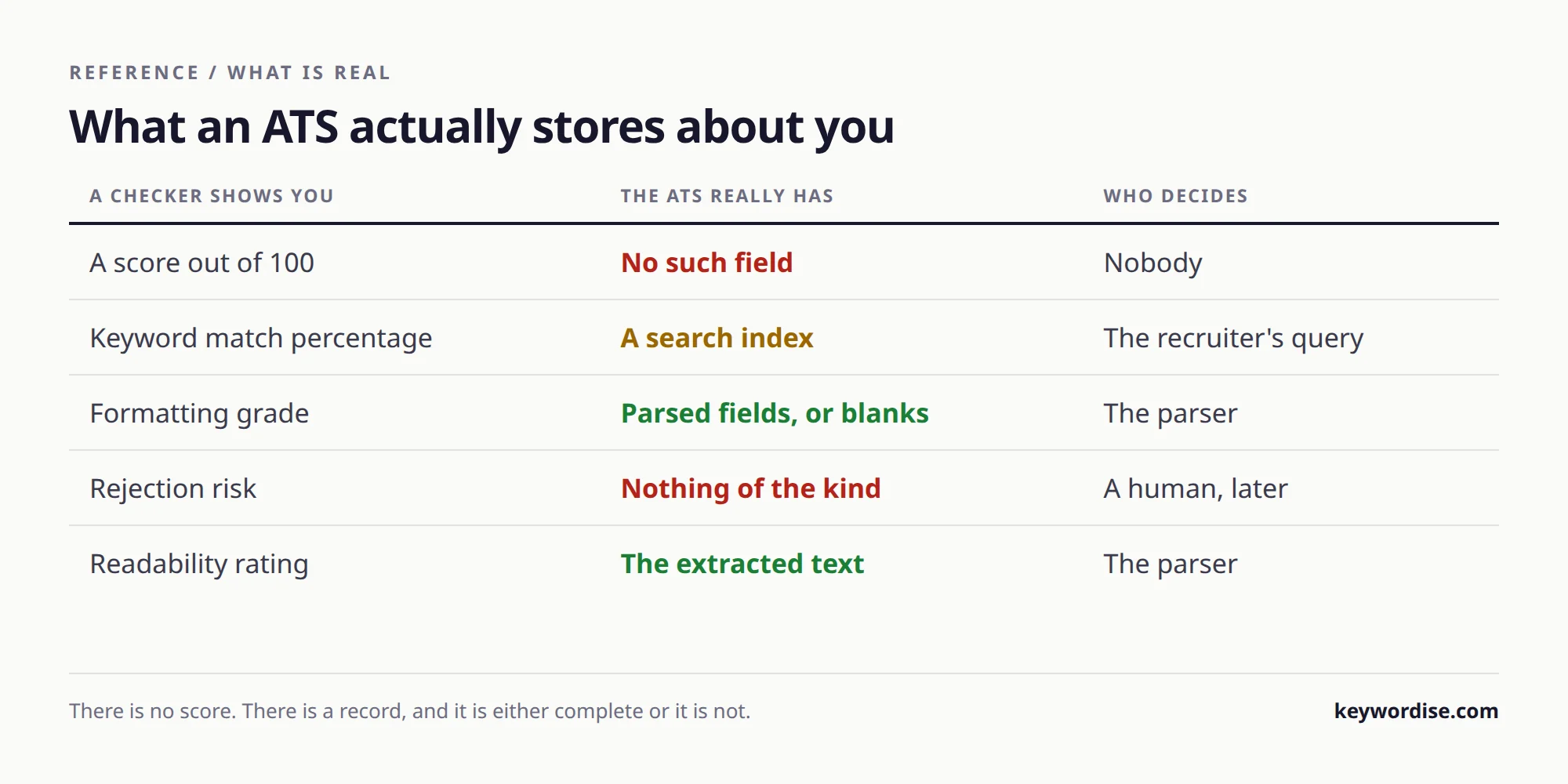
No applicant tracking system publishes a portable score, and no external checker can read the ranking a specific employer sees. What exists inside a system is a match ranking against one posting, computed with that vendor's own logic and visible to the recruiter, not to you.
An analysis of more than 1.7 million applications found that these platforms do not auto-reject on a score at all: they parse, index and rank for a human who then filters. The score you are being sold is a proxy invented by the tool selling it.
What a checker is genuinely good for
A checker earns its place by showing you the text a parser actually extracted, because that is the one thing you can fix. Judge a tool by whether it shows you the extraction, not by whether it gives you a number.
| What a checker reports | Trust it? | What to do with it |
|---|---|---|
| The extracted plain text | Yes | Read it and fix what is missing or scrambled |
| Detected sections and dates | Yes | Confirm employer, title and dates were found |
| A percentage match score | No | It is the tool's own formula, not the employer's |
| Keyword gaps versus the posting | Partly | Useful as a prompt, never as a checklist to stuff |
The free check that needs no tool
Open your PDF, select all, copy, and paste it into a plain text editor. That is the same operation a parser performs, and it finds most real failures in under five minutes.
- Is the very first line your name, rather than your profile paragraph?
- Do Experience, Education and Skills appear as whole words?
- Did your email survive as one unbroken token?
- Has anything from a sidebar landed inside a job entry?
- Are all your dates in the same format, and did every one survive?
We built that check into a scored form and ran it on our own document: two columns passed 4 of 9, one column passed 9 of 9. The method and the per-system differences are in what actually parses in 2026, and the template side is in what makes a template parse.
Run the extraction yourself, with the same library parsers use
The plain-text copy-paste check finds most failures, but if you want the same view a parser gets, extract the PDF with a text-extraction library and read the output. That is exactly how we produced our own numbers, and it is free.
- Extract in strict position order, which is the harshest reading and the one that exposes columns.
- Then extract in column-aware mode and compare: a big difference means your layout is ambiguous.
- Check the first non-empty line is your name in BOTH runs.
- Search the output for your email as one unbroken string.
What a good checker report contains
Judge a paid checker on whether it hands you the extraction and the detected fields, not on the size of its number. If the report is a score and a list of missing keywords, you have bought an opinion.
| Report element | Worth paying for | Why |
|---|---|---|
| The extracted text, in full | Yes | It is the only thing you can act on |
| Detected employer, title, dates | Yes | Shows whether field mapping worked |
| A single overall score | No | Not a number any employer sees |
| Missing keyword list | Careful | Useful as a prompt, dangerous as a checklist |
| Rewrite suggestions | Careful | Check each against what you actually did |
When a low score is telling you nothing
Two checkers will disagree on the same file, because each scores against its own model of the posting. If one says 62% and another says 88%, neither number is wrong; they are measuring different things, and neither is what the employer sees.
Sources
Every source here was fetched and checked before it was linked. Our own parser numbers are reproducible: render the same CV in both layouts and extract it.
- Huntr, how applicant tracking systems actually work (1.7M+ applications analysed)
- ResumeAdapter, where the 75% rejection figure actually comes from
- SelectSoftwareReviews, applicant tracking system statistics
Stop sending the same CV
Keywordise writes a fresh, truthful CV for every job and applies for you. 7-day free trial, 27 free applications, no card.
Start free →Frequently asked questions
Is there a real ATS score I can check?
No. No applicant tracking system publishes a portable score, and no external checker can read the ranking a specific employer sees. What exists is a match ranking against one posting, computed with that vendor's logic and shown to the recruiter.
Are ATS resume checkers accurate?
They are accurate about the extraction and invented about the score. The plain text a checker shows you is genuinely what a parser produced; the percentage beside it is the tool's own formula.
What is the best free ATS resume checker?
The one you already have: paste your PDF into a plain text editor. It performs the same operation a parser does and finds most real failures. Use a paid checker when you want the extraction presented section by section rather than raw.
Will my resume pass the ATS?
It passes if the text extracts in the right order with your name first, standard headings intact and nothing from a sidebar inside a job entry. That is checkable in five minutes and is a better question than asking for a score.
Does an ATS reject my resume automatically?
Analyses of more than 1.7 million applications find no auto-rejection on a score. The systems parse, index and rank for a human who filters. Rejections that feel automatic usually trace to a parsing failure that indexed you wrongly.
What does an ATS score of 80% mean?
It means the tool that produced it scored you 80% against its own model of the posting. It is not a number the employer sees and two checkers will disagree on the same file.
Should I pay for an ATS checker?
Only if it shows you the extracted text and the detected fields. A tool that returns a score without showing the extraction is selling you a number you cannot act on.
How do I improve my ATS results?
Fix the format first so the file extracts cleanly, then align the wording with the posting's own responsibilities. In that order, because tailoring the words inside an unreadable file changes nothing.