ATS friendly resume template and format: what actually parses

The template decides more of the outcome than the words in it, and free galleries are sorted by looks, which is exactly the wrong axis. Here is what parses.
The template you choose decides more of the outcome than the words you put in it. Most free template galleries are sorted by how they look, which is exactly the wrong axis, because the most attractive designs are the ones an extractor handles worst.
What makes a template ATS friendly
One column, real selectable text, standard section headings, and nothing important drawn as a graphic. Every other design decision is free.
| Template feature | Parses | Why |
|---|---|---|
| Single column | Yes | Reading order is unambiguous at any page width |
| Two columns or a sidebar | Often not | Position-sorting parsers interleave them |
| Skills as rating bars or stars | No | A drawn bar carries no text at all |
| Contact block in the page header | Often not | Several parsers never read the header region |
| Letter-spaced display headings | No | Each glyph lands at its own coordinate |
We ran the comparison ourselves
Same CV, same words, two templates: the designed two-column version passed 4 of 9 parser checks and the plain single-column version passed 9 of 9. Fifteen fragments from the sidebar were dealt into the middle of job entries.
The failure that surprised us is that a column-aware parser did not rescue it either. Full method and the per-system behaviour are in what actually parses in 2026.
Free template sources, and the catch
A plain document in Word, Google Docs or LibreOffice is already an ATS friendly template; you do not have to download anything. The catch with gallery templates is usually the export step, not the design.
- Headings as real text, not as an image or a shape.
- Dates written the same way every time, MM.YYYY throughout.
- No table wrapped around your work history, even an invisible one.
- Export and paste into a plain text editor before you trust it.
Then make it match the posting
A parseable template gets you read; it does not get you shortlisted. Once the format is right, the work moves to relevance: the four edits that matter, and whether a builder is worth paying for.
Build one in Word or Google Docs in ten minutes
You do not need a template file at all: a blank document with four headings and consistent dates is already ATS friendly. This is the whole build, and it costs nothing.
- Name on line one, on its own, in the body and not in a header.
- Contact details on the next three lines, one item per line.
- Four headings as plain bold text: Experience, Education, Skills, Languages.
- Each role as employer, title, MM.YYYY to MM.YYYY, then bullets.
- No columns, no text boxes, no tables around the history, no images of text.
Can an ATS friendly CV still look designed?
Yes, because extraction does not care about anything you can change with a font menu. Typeface, size, weight, colour, spacing and a restrained accent rule all survive intact. What does not survive is structure used as decoration.
| Design choice | Survives extraction | Note |
|---|---|---|
| Font, size, weight, colour | Yes | Purely visual, no effect on the text layer |
| Whitespace and line spacing | Yes | Often improves how a human reads it too |
| A horizontal rule under headings | Yes | Drawn, but nothing depends on it |
| Two columns | No | Reading order becomes ambiguous |
| Letter-spaced small caps | No | Each glyph lands at its own coordinate |
One template, two exports
Keep one source document and export it twice: PDF for email and a named human, DOCX for an upload box whose vendor you do not know. Maintaining two separate documents is how they drift apart and how the wrong one gets sent.
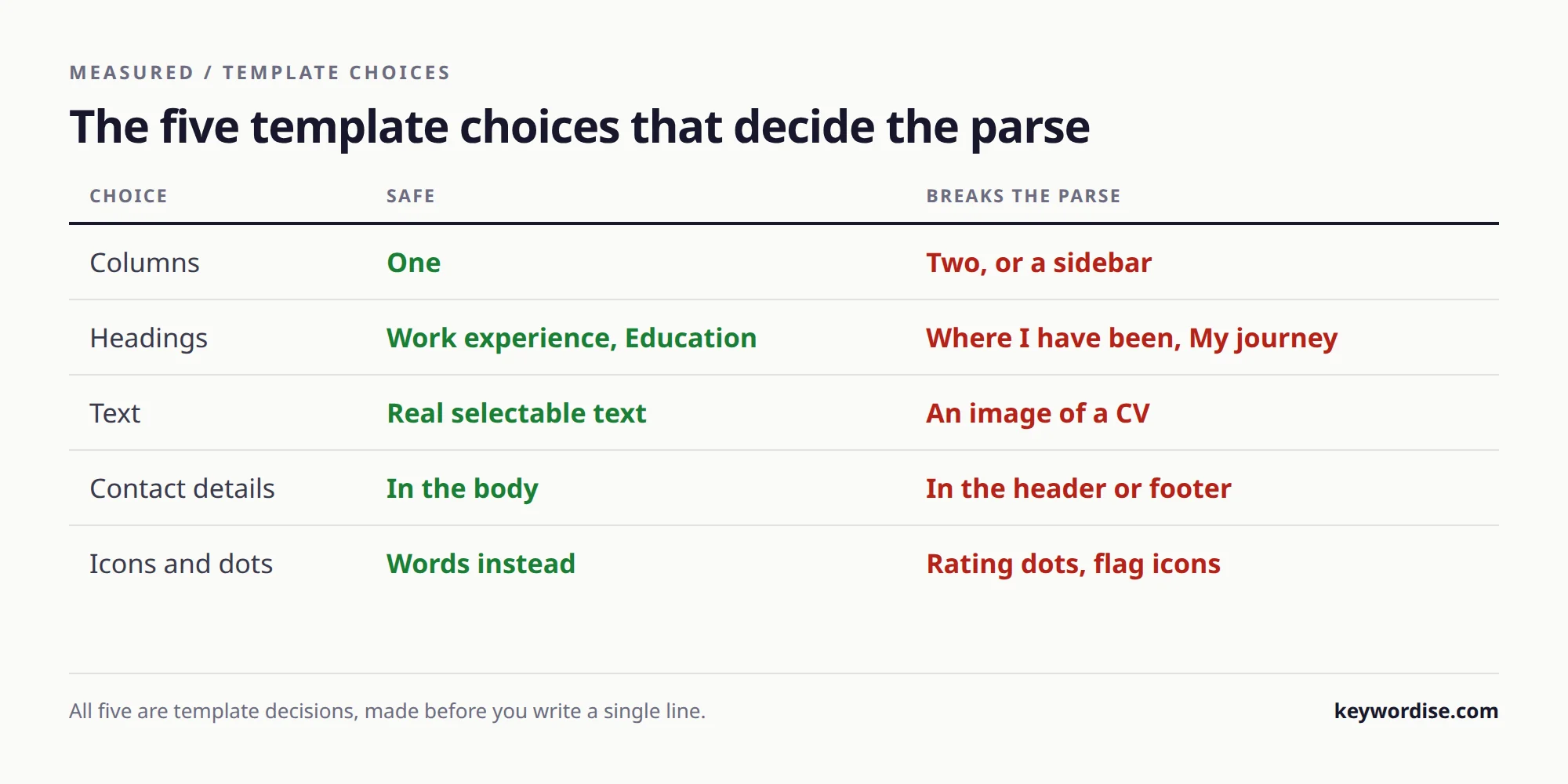
The template decides whether your CV parses, and you choose the template before you have written a single line. That is why the format question comes first and not last.
Why the template is the decision
Sources
Every source here was fetched and checked before it was linked. Our own parser numbers are reproducible: render the same CV in both layouts and extract it.
- ResumeSquad, how the major ATS platforms differ in parsing
- OneHour Digital, ATS filtering and keyword screening statistics
- Huntr, how applicant tracking systems actually work (1.7M+ applications analysed)
Stop sending the same CV
Keywordise writes a fresh, truthful CV for every job and applies for you. 7-day free trial, 27 free applications, no card.
Start free →Frequently asked questions
What is the best ATS friendly resume template in 2026?
A single-column document with real text headings, consistent MM.YYYY dates and no tables, sidebars or skill bars. A plain Word or Google Docs file already qualifies, which is why the best template is usually the one you did not download.
Are free resume templates ATS friendly?
Many are not, because galleries sort by appearance and the most attractive designs use two columns and sidebars. We measured the same CV at 4 of 9 parser checks in a two-column template against 9 of 9 in a single column.
Does an ATS friendly resume have to look boring?
No. Typeface, spacing, colour for headings and a restrained accent all survive extraction. What does not survive is structural decoration: columns, text boxes, and information drawn as a graphic.
Can I use a table in an ATS resume?
Avoid it around your work history. Some parsers flatten tables in ways that mix dates into bullet text. A small table for a skills list is lower risk, but a plain separated line is safer still.
What is the right ATS friendly resume format, PDF or Word?
PDF is safe for email and modern platforms. DOCX parses more reliably across older and stricter systems and several 2026 comparisons put it ahead for portal uploads. If both are accepted and you do not know the vendor, choose DOCX.
Should my resume template include a photo?
It depends on the country, not on the parser. We measured a floated photo leaving the extracted text byte-identical. In the US, UK, Canada and Ireland leave it out; across continental Europe and the CIS it is conventional.
How many pages should an ATS friendly resume be?
As many as your history genuinely needs, usually one to two. Parsers read every page; the page count matters to the human, so the real rule is that nothing on page two should be something a recruiter needed on page one.
Do ATS friendly templates work in other languages?
Yes, the structural rules are language independent. What changes is the heading vocabulary, which must be the standard terms in that language, because a parser matches the words that language actually uses.