UK CV vs US resume: the six differences that matter

A UK CV and a US resume are different documents with different rules, and sending one where the other is expected is a quiet and very common mistake.
CV and resume are treated as synonyms in conversation and they are not the same document. If you are applying across the Atlantic in either direction, five things change, and a reader in the receiving market notices all five at once.
The seven rows that decide it
Two pages against one, a personal statement against a summary, British spelling against American, and references named differently in each. Photos are wrong in both, which surprises people arriving from continental Europe more than it surprises anyone else.
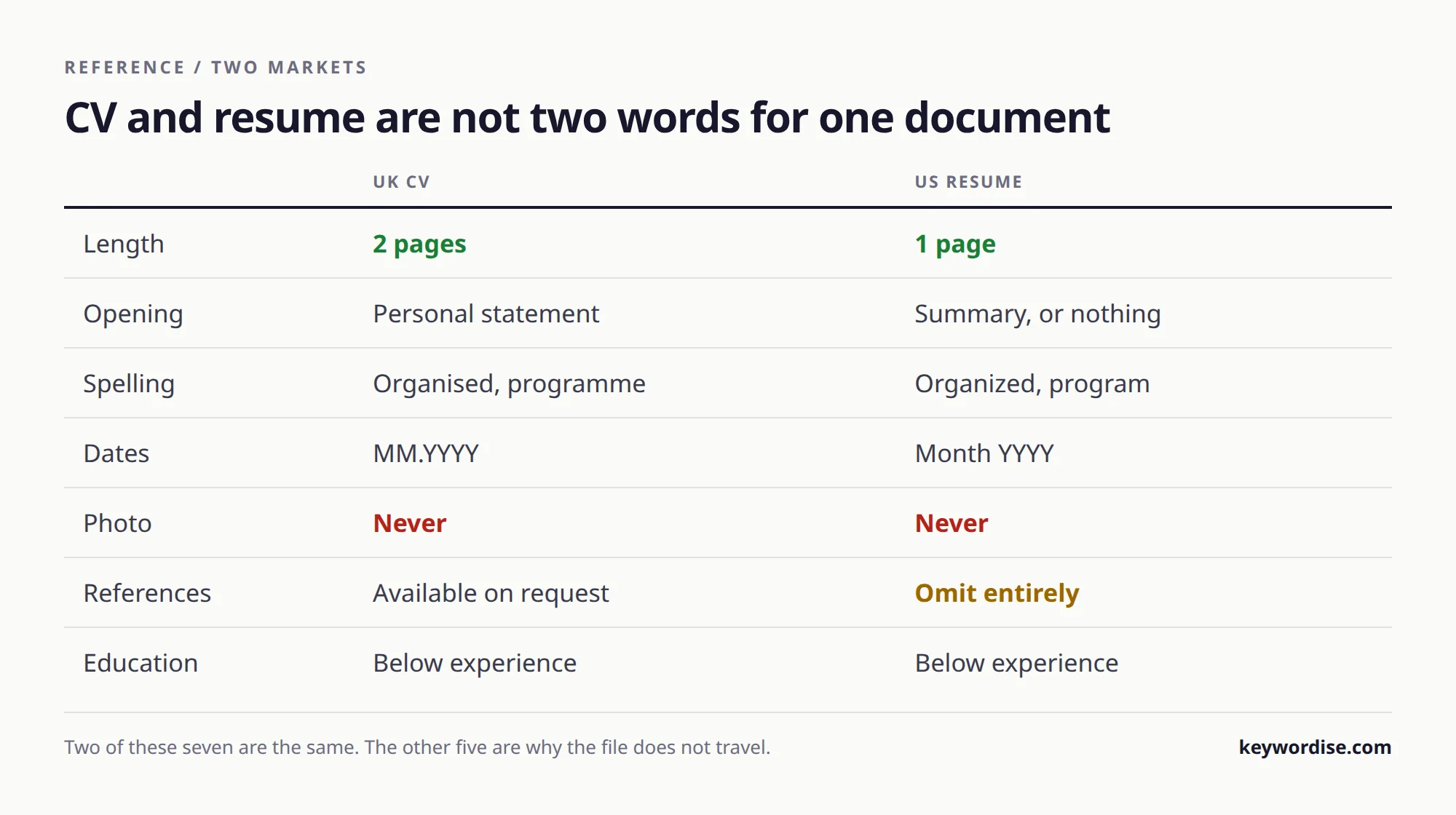
One page is a US rule, not a universal one
The one-page rule is the single piece of advice that travels worst. In the US it is real for anyone under roughly ten years of experience. In the UK a one-page CV from an experienced candidate reads as thin rather than disciplined, and the reader assumes something is missing.
The content of your career is the same on both sides of the Atlantic. What changes is what the reader has been trained to expect, and that is not something you can argue with from the page.
Why the same file does not work twice
The personal statement has no American equivalent
A UK personal statement is three or four lines in the first person, saying what you are, what you have done that this employer needs, and what you want next. A US summary is shorter, written without pronouns, and increasingly left out altogether in favour of going straight to the most recent role.
| Applying | Change first | Then |
|---|---|---|
| US resume to a UK employer | Expand to two pages | Add a personal statement, switch to British spelling |
| UK CV to a US employer | Cut to one page | Drop the references line, switch to American spelling |
| Either, from continental Europe | Remove photo and date of birth | Both markets treat them as a liability |
| Either, to any market | Single column, real text | A parser reads the file before a person does |
What does not change
The format rules are identical in both markets, because they are not cultural: they are what the software can read. We measured the same content at 4 of 9 parser checks in two columns against 9 of 9 in one, and that result does not care which country the employer is in. See what actually parses.
- One column, no text boxes, no sidebar, in both markets.
- Standard headings: Work experience, Education, Skills.
- Real selectable text, not a picture of a CV.
- Dates in a consistent format, whichever format the market uses.
- A file name with your actual name in it.
Sources
Every source here was fetched and checked before it was linked.
- National Careers Service, the sections a UK CV is expected to carry
- Prospects, UK example CVs and the conventional order
- Acas, age discrimination and what employers may ask
- Huntr, how applicant tracking systems actually work
Stop sending the same CV
Keywordise writes a fresh, truthful CV for every job and applies for you. 7-day free trial, 27 free applications, no card.
Start free →Frequently asked questions
What is the difference between a CV and a resume?
In the UK a CV is the standard two-page application document. In the US a resume is one page and a CV means a long academic record. Same purpose, different conventions and different length.
How long should a UK CV be compared with a US resume?
Two pages in the UK, one in the US for anyone under roughly ten years of experience. A one-page CV from an experienced UK candidate reads as thin rather than disciplined.
Do I need a personal statement for a US application?
No. The US equivalent is a short summary without pronouns, and many strong resumes leave it out and open with the most recent role instead.
Should I change my spelling?
Yes. Organised for the UK, organized for the US. It is a small signal that the document was written for that employer rather than forwarded from another application.
Do I put references on either document?
In the UK, either omit them or write available on request. In the US, omit them entirely; the line is considered filler.
Can I send the same file to both markets?
Not without editing. Five of the seven conventions differ, and a reader in the receiving market notices all of them at once.
Does either market want a photo?
No. Both the UK and the US treat a photo as discrimination exposure. This is the rule that most surprises applicants from Germany, Austria and Switzerland.
Do the ATS rules differ between the UK and the US?
No. Single column, real text and standard headings are software rules, not cultural ones. We measured 4 of 9 parser checks for a two-column CV against 9 of 9 for one column, in both cases.