Job application tracker: the six fields that matter

Past about twenty applications, the thing costing you interviews is not the CV. It is forgetting which version went where, and missing the follow-up window.
Once you are past about twenty applications, the thing that costs you interviews is no longer the CV. It is forgetting which version you sent where, and missing the follow-up window on the one that was actually interested.
What a tracker has to hold
Six fields carry almost all the value: company, role, date applied, which CV version you sent, the source, and the next action with a date on it. Everything beyond that is decoration you will stop maintaining within a week.
| Field | Why it earns its place |
|---|---|
| Company and role | The obvious pair, and the one you will misremember first |
| Date applied | Turns silence into information: past four weeks is usually a no |
| CV version sent | So the interview matches the document they actually read |
| Source | Tells you which channel produces replies, not just applications |
| Next action and date | The single field that converts a list into a process |
| Outcome | Gives you a callback rate that is yours rather than an average |
A spreadsheet is usually the right answer
Dedicated trackers exist and several are good, but a six-column sheet you actually update beats a rich tool you abandon in week two. Choose the tool by whether it lowers the cost of the update, because that is the only thing that decides whether the tracker survives.
- If updating takes more than fifteen seconds per application, it will not happen.
- Auto-capture from your inbox is the one feature that genuinely changes the odds.
- One row per application, never one per company.
- Review weekly, not daily. Daily produces anxiety, not decisions.
What the tracker is actually for
After thirty rows you can compute your own callback rate, and that number is what tells you whether to send more applications or fix the ones you send. If it sits under 2 percent, volume is not the problem: check the file parses at all, in what a checker can tell you, then work backwards from interviews.
The weekly review that makes the tracker worth keeping
A tracker nobody reviews is a diary, and a diary changes nothing. Fifteen minutes once a week turns the rows into three decisions.
- Which applications passed four weeks with no reply: close them and stop waiting.
- Which are due a follow-up this week: send it, once.
- Which source produced replies rather than applications: do more of that one.
- What your rate is now, and whether last week's change moved it.
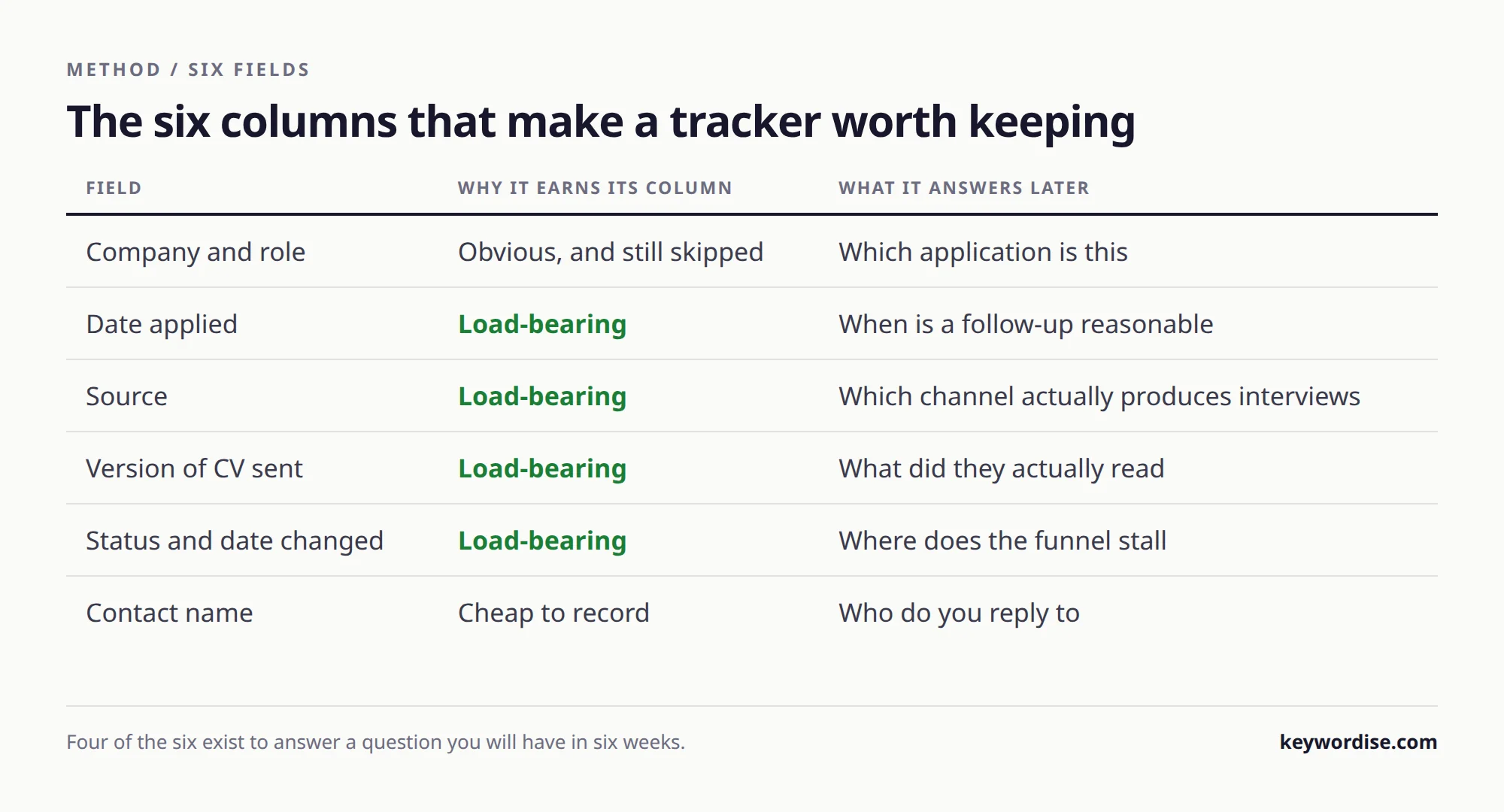
A tracker that records only company, role and status tells you what happened and never why. Source and CV version are the two columns that turn a list into something you can learn from.
The two fields people leave out
Sources
Every source here was fetched and checked before it was linked. Our own parser numbers are reproducible: render the same CV in both layouts and extract it.
Stop sending the same CV
Keywordise writes a fresh, truthful CV for every job and applies for you. 7-day free trial, 27 free applications, no card.
Start free →Frequently asked questions
What is the best job application tracker?
The one you will still be updating in week three. A six-column spreadsheet beats a feature-rich tool you abandon. Judge any tracker by how long a single update takes: past about fifteen seconds per application, it stops happening.
What should I track for each job application?
Company, role, date applied, which CV version you sent, the source, and the next action with a date. Add outcome when it arrives. Everything else is decoration.
Should I use a spreadsheet or an app?
A spreadsheet unless the app captures applications from your inbox automatically. Auto-capture is the one feature that genuinely changes the odds, because it removes the step people skip.
How do I calculate my callback rate?
Replies of any kind divided by applications sent, over at least thirty applications. Below thirty the number moves too much to act on. Above 10 percent your targeting is working; below 2 percent something upstream is broken.
How long should I wait before following up?
About a week after applying, then once more a week later. Most replies that come at all arrive within two weeks, and silence past four weeks is usually a no.
Why track which CV version I sent?
So the interview matches the document they read. If you tailor per posting and do not record which variant went where, you will be asked about a bullet you cannot see.
Is tracking applications actually worth the time?
It costs about fifteen seconds per application and it is the only way to get a callback rate that is yours. Without it you are using averages from people whose search does not resemble yours.
Can I track applications automatically?
Some tools capture confirmation emails from your inbox and create rows for you. That is worth paying for; a prettier manual interface is not.