CV format UK: the shape British employers expect

UK employers expect a shape, not just content. Most of the rules are unwritten, which is why applicants from outside get the content right and the shape subtly wrong.
UK employers expect a shape, not just content. Most of the rules are unwritten, which is why applicants from outside the UK get the content right and the shape subtly wrong. Below is the shape, section by section, plus the three habits that mark a CV as written for a different market.
The section order a UK employer expects
Name and contact, personal statement, work experience, education, skills, then anything else. Education moves above experience only while you are a student or within about a year of graduating. Once you have real experience, that is what a reader opens the document for.
- No photo, no date of birth, no marital status. All three are liabilities.
- Two pages is the norm. One is fine early on and three needs a reason.
- Reverse chronological within each section, most recent first.
- Dates as MM.YYYY, consistently, including for education.
- British spelling throughout: organised, programme, specialise.
What belongs on page one
A UK reader decides on page one and confirms on page two. That is not a rule anyone publishes, but it is how the document is actually read, and it tells you what may be moved down.
| Where | What it carries | Why there |
|---|---|---|
| Top of page 1 | Name, city, phone, email, LinkedIn | A recruiter needs to reach you before they need to be impressed |
| Page 1 | Personal statement and the two most recent roles | This is the part that decides whether page 2 is read at all |
| Page 2 | Earlier roles, education, skills, extras | Confirmation, not persuasion |
| Nowhere | Photo, date of birth, marital status, full address | Each one adds discrimination exposure and no information |
Photo, date of birth and the market you learned in
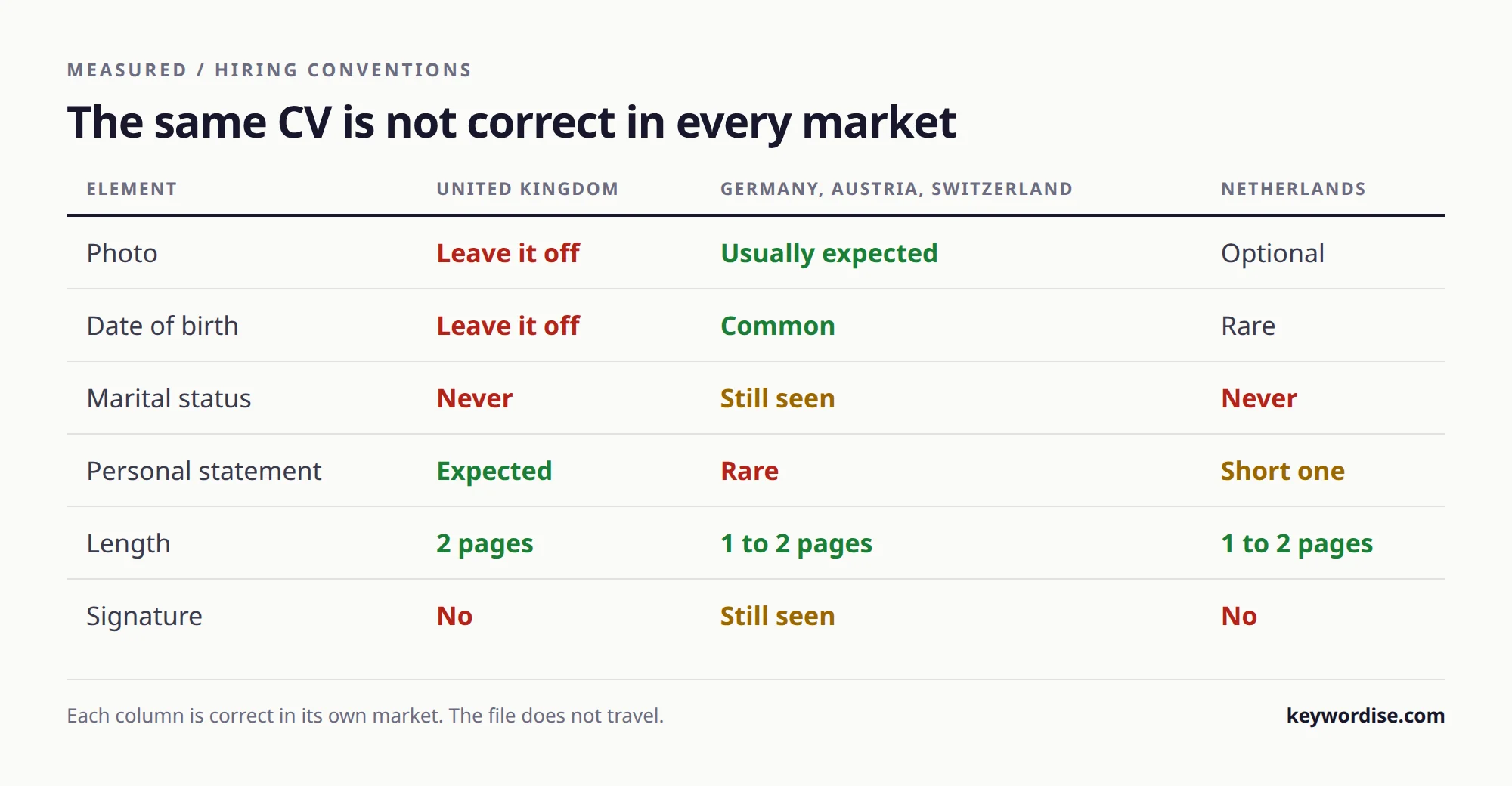
On this one question the UK follows the American convention rather than the continental one, and that surprises almost every applicant arriving from Germany, Austria or Switzerland. Age is a protected characteristic under the Equality Act 2010, so a CV that volunteers a date of birth hands the employer a problem they did not ask for. Some employers strip the photo before a hiring manager sees the file; others simply move on to the next candidate.
The same CV cannot be correct in London and in Munich. The content travels; the conventions around it do not.
Working rule behind the market table above
The personal statement, in three or four lines
The UK personal statement is the one section with no continental equivalent, which is why it is usually either missing or four times too long. It is not a cover letter and it is not a mission statement.
- What you are, with the number of years: a supply chain analyst with six years in FMCG.
- What you have actually done that this employer needs.
- What you are looking for, in one clause, matching the advert.
- No adjectives you cannot evidence lower down the page.
- Rewrite the last clause for each application. The rest can stand.
Where non-UK applicants give themselves away
A photo, a date of birth and a one-page American summary are the three tells, and each one is a habit from a market where it is correct. None of them is a mistake at home, which is exactly why they survive the move.
- Continental Europe: drop the photo and the date of birth for the UK.
- United States: expand to two pages and add a personal statement.
- Everywhere: British spelling, organised rather than organized.
- Grades: give the UK equivalent where you are confident, or name the system used.
- References: omit them, or write available on request.
The format rules that are not British at all
One column, real text, standard headings: those are parser rules and they apply in every country. We measured a two-column CV at 4 of 9 parser checks against 9 of 9 for the same content in a single column, and the failures were not cosmetic: the name was not read as the name and sidebar fragments landed inside the work history. See what actually parses.
Before you send it
- Two pages, one column, no text boxes and no sidebar.
- No photo, no date of birth, no marital status, no full street address.
- MM.YYYY dates everywhere, including education.
- British spelling, checked once by eye and not only by a spellchecker set to US.
- A personal statement whose last clause names this employer's problem.
- Saved as PDF, with the text still selectable when you open it.
Sources
Every source here was fetched and checked before it was linked. Our own parser numbers are reproducible: render the same CV in both layouts and extract it.
- National Careers Service, the sections a UK CV is expected to carry
- Prospects, UK example CVs and the conventional order
- Acas, age discrimination and what employers may ask
- Equality Act 2010 s5, age as a protected characteristic
- Huntr, how applicant tracking systems actually work
Stop sending the same CV
Keywordise writes a fresh, truthful CV for every job and applies for you. 7-day free trial, 27 free applications, no card.
Start free →Frequently asked questions
What is the correct CV format for the UK?
Name and contact, a three to four line personal statement, work experience, education, skills. Two pages, reverse chronological, MM.YYYY dates, no photo and no date of birth.
Should a UK CV have a photo?
No. The UK follows the US convention: a photo raises discrimination exposure and some employers strip or discard CVs carrying one. Continental Europe is the opposite, which is why the same file does not travel.
How many pages should a UK CV be?
Two is the norm. One is fine in the first years of a career. Three needs a reason, usually academic or a long technical history, and nothing on page three should be something the reader needed earlier.
Do I put my date of birth on a UK CV?
No. Age is a protected characteristic under the Equality Act 2010, and including it invites a discrimination problem the employer would rather avoid, which makes your CV the inconvenient one.
Where does education go on a UK CV?
Below work experience, unless you are a student or graduated within about a year. Once you have real experience, it is the experience a reader wants first.
Should I use British spelling on my CV?
Yes, for a UK employer. Organised, programme, specialise. It is a small signal that the document was written for them rather than forwarded from another application.
Do I include references on a UK CV?
Either omit them or write available on request. Listing names and contact details spends space and exposes your referees before there is an offer in view.
How do I present non-UK qualifications?
Give the qualification as awarded, then a UK equivalent in brackets if you are confident of it. If you are not, name the country and the system and let the reader judge.
What is a personal statement on a UK CV?
Three or four lines at the top saying what you are, what you have done that this employer needs, and what you are looking for. It is not a cover letter, and only its last clause needs rewriting per application.
Does a two-column CV work in the UK?
Not reliably. We measured the same content at 4 of 9 parser checks in two columns against 9 of 9 in one, and that failure has nothing to do with the UK: it happens wherever the file is read by software first.