Career change CV: translate the work, keep the timeline

A career change CV fails predictably: it describes the job you are leaving accurately and leaves the reader to work out why any of it matters.
A career change CV has one job: make a reader in the new field recognise work they already value, described in words they already use. That is a translation problem, and almost every piece of advice about it recommends destroying the evidence instead.
Keep the timeline. Translate the content.
Reverse chronological, real employers, real titles, real dates. The functional or skills-based CV is sold as the answer for career changers and it is the one format experienced readers distrust on sight, because its only purpose is to stop them seeing when things happened.
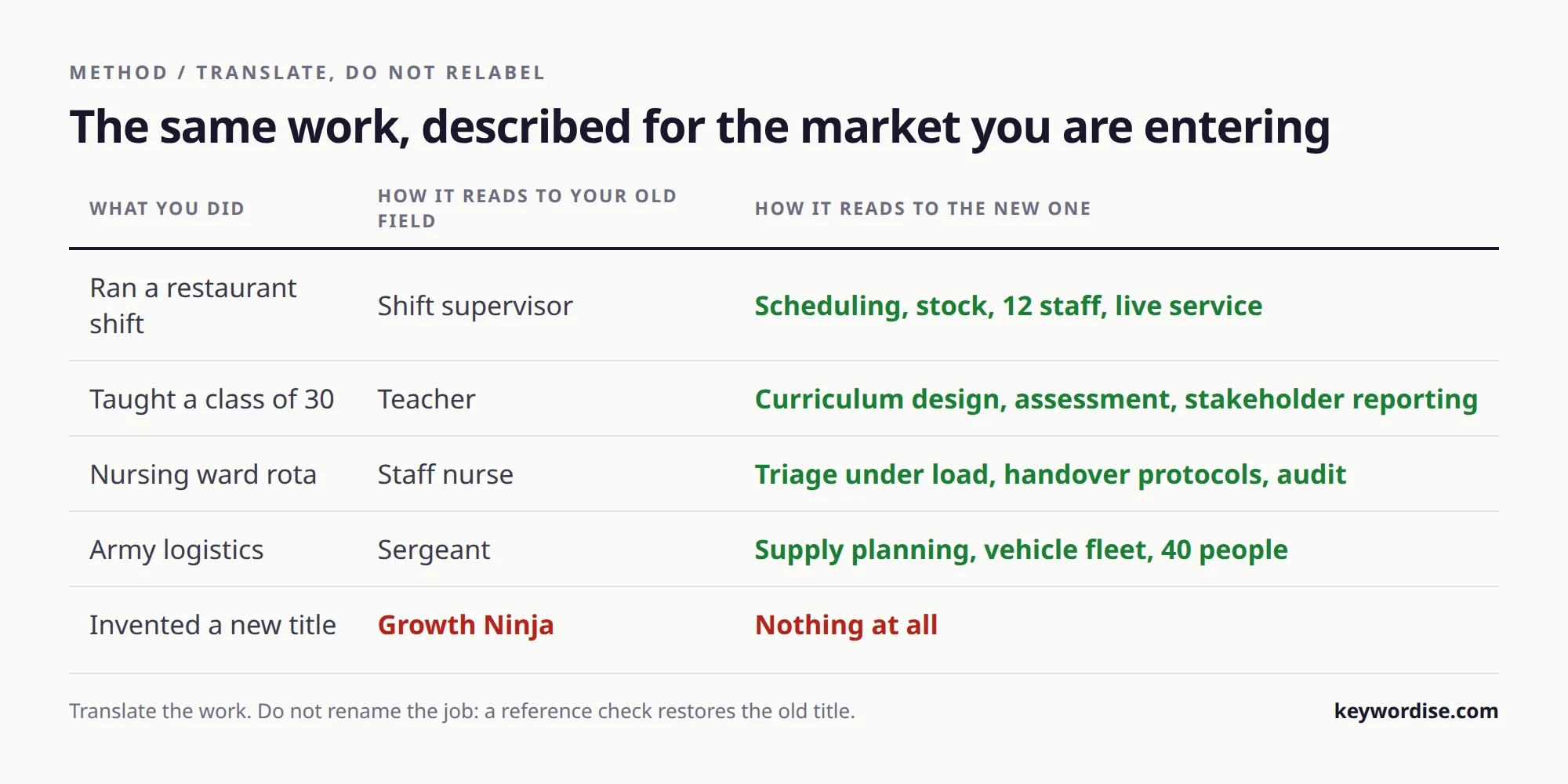
What translation actually means
Translation is describing the same facts in the receiving field's vocabulary. It is not renaming your job, which a reference check undoes in one phone call, and it is not claiming a tool you have never opened. Everything in the right-hand column of the table above is something the person actually did.
A functional CV answers a question nobody asked and hides the one thing every reader checks first. If the dates are fine, show them; if they are not, explain them.
Why the timeline stays
The four lines that carry a change
A career change CV does most of its work in four places, and the rest of the document is the ordinary document you would have written anyway.
| Where | What it does | What goes wrong |
|---|---|---|
| The opening summary | Names the change in one sentence and closes it | Apologising for the change, or hiding it |
| The most recent role | Described entirely in the new field's vocabulary | Described for the field you are leaving |
| One bridging line | Course, certification, project, or volunteer work | A course with no completion date and no output |
| Older roles | Compressed to two lines each, kept for the timeline | Deleted, which creates a gap where there was none |
Say the change out loud, once
One sentence at the top, stated as a decision rather than a hope: a restaurant manager of six years moving into operations, with the scheduling and stock work that already overlaps. Naming it closes the question. Leaving it unnamed means the reader spends the whole first page working out what they are looking at.
- State the change as a decision, in one sentence, at the top.
- Rewrite the most recent role for the field you are entering, not the one you are leaving.
- Keep every title exactly as your employer would confirm it.
- One bridging line with a real completion date beats three courses in progress.
- Compress older roles to two lines rather than deleting them.
- Numbers translate across every field: people, budget, volume, time.
What the software does to a functional CV
A skills-based layout does not just fail with human readers; it fails the parse first. Employment history is stored as title, employer and date range, so a document that groups achievements under skill headings has nothing to put in those fields, and the record that reaches the recruiter's database is close to empty. We measured a two-column CV at 4 of 9 parser checks against 9 of 9 for a single column, and a functional layout compounds the same problem. See what actually parses.
Sources
Every source here was fetched and checked before it was linked. Our own parser numbers are reproducible: render the same CV in both layouts and extract it.
- National Careers Service, how a CV is structured
- Prospects, example CVs including career change formats
- Huntr, how applicant tracking systems index titles and dates
- ResumeSquad, how the major ATS platforms differ in parsing
Stop sending the same CV
Keywordise writes a fresh, truthful CV for every job and applies for you. 7-day free trial, 27 free applications, no card.
Start free →Frequently asked questions
How do I write a CV for a career change?
Keep the reverse chronological timeline and rewrite the content in the new field's vocabulary. State the change as a decision in one sentence at the top, and add one bridging line: a course, certification or project with a real completion date.
Should I use a functional or skills-based CV?
No. Experienced readers distrust it because its only purpose is to obscure dates, and it fails the parse as well: employment history is stored as title, employer and date range, and a functional layout has nothing to put in those fields.
Do I delete jobs from the field I am leaving?
No. Compress them to two lines each and keep them. Deleting them creates a gap where there was none, and a gap is a question you now have to answer.
Can I change my job title to something the new field recognises?
No. Keep the title exactly as your employer would confirm it and translate the description underneath. A renamed title survives the CV and not the reference check.
What transfers between fields?
Numbers transfer everywhere: people managed, budget held, volume handled, time under pressure. So do scheduling, stakeholder communication, audit and training, once they are described in the receiving field's words.
Is a course enough to make a change credible?
One finished thing beats three in progress. A completion date and an output, even a small project, is what makes the line evidence rather than intention.
Where do I explain why I am changing?
One sentence at the top of the CV, and properly in the cover letter. Stated as a decision, not as an apology, and once only.
Do I need a different CV for every application?
For a career change, the most recent role and the opening sentence should be rewritten for each target. The timeline and older roles stay as they are.