Writing a CV with AI: the half it actually does well

Writing a CV with AI works for exactly one half of the job. Knowing which half saves you from the failure that ends interviews.
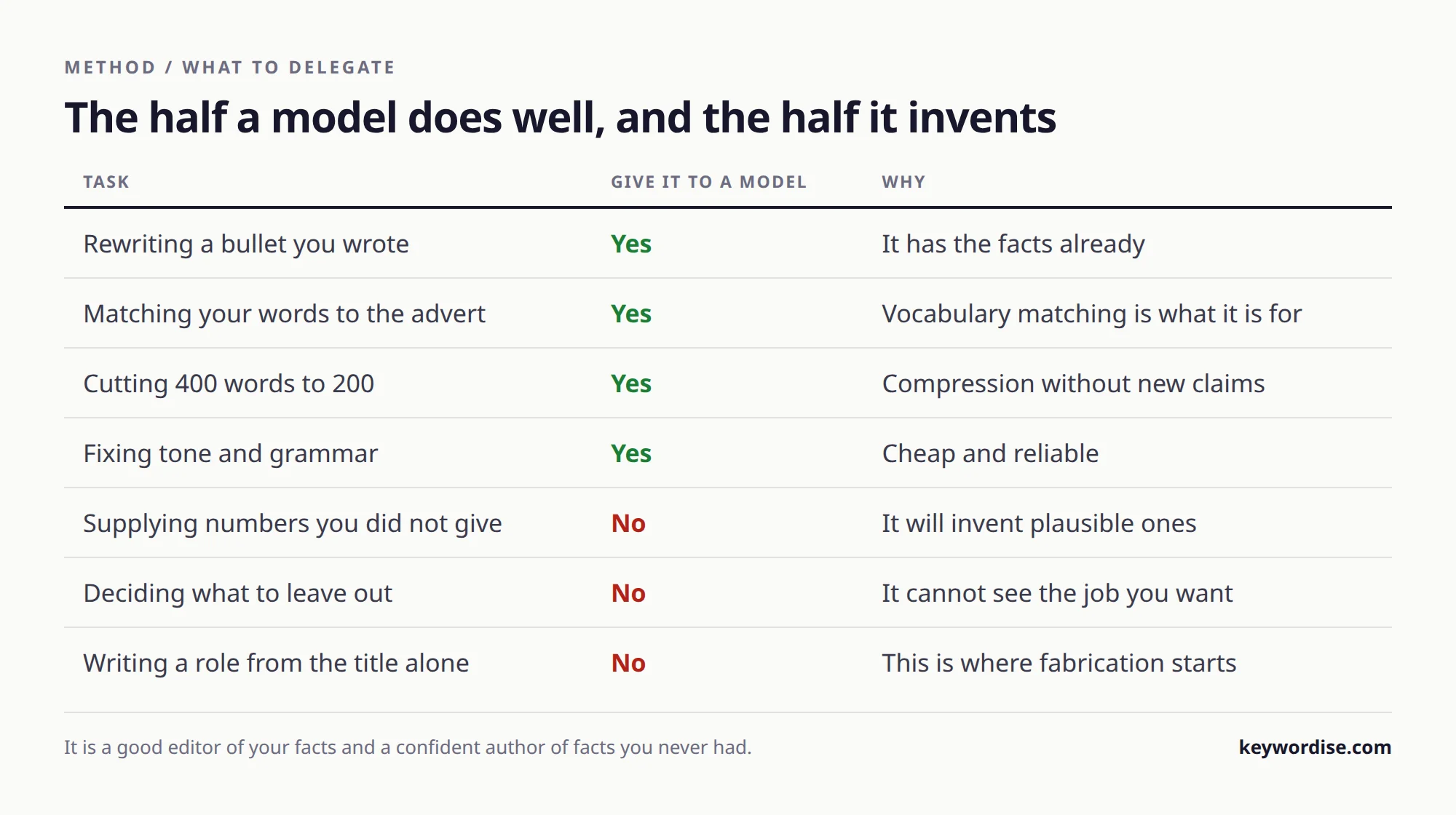
A language model is a good editor of your CV and a bad author of it. The distinction is not about quality of writing, which is usually fine. It is about which half of the job requires knowing things only you know.
Edit your facts, do not order new ones
Give it what you did and ask for better sentences. Do not give it a job title and ask what you probably did. The second prompt produces confident, well written work you never carried out, and it is the source of almost every story about AI ruining a CV.
The four tells of an unedited draft
Recruiters recognise a generated CV quickly, and not because it is badly written. They recognise it because it is evenly written: every role sounds equally important and nothing sounds like a person remembering their own work.
- Every bullet is the same length and the same shape.
- Spearheaded, leveraged, orchestrated, three times each.
- Round numbers with no unit anyone would use internally: improved efficiency by 30%.
- A skills list containing tools that appear nowhere in the roles above it.
- A summary that would fit any candidate in the same job family.
A model cannot tell you what you did. It can only tell you how something like that is usually described, which is a different thing wearing the same sentence.
Why the facts have to come from you
A prompt that does not invent anything
The fix is to close the door rather than to ask nicely. Supply the facts, supply the advert, and forbid anything that is not in either. A model told explicitly that it may not add numbers will ask you for them instead of inventing them.
| Put this in the prompt | What it prevents |
|---|---|
| Here are my actual bullet points, verbatim | A draft built from the job title alone |
| Here is the advert. Use its vocabulary where it honestly matches | Keyword stuffing that reads as a different person |
| Do not add any number, tool or client I have not given you | Invented metrics and software you have never opened |
| Ask me for anything missing rather than filling it in | The silent gap-filling that produces the confident fiction |
| Keep each bullet under two lines, vary the openings | The evenly written draft every recruiter recognises |
What a model cannot help with at all
The format is not a writing problem, so no amount of prompting fixes it. A model producing beautiful prose inside a two-column template has produced a document we measured at 4 of 9 parser checks, against 9 of 9 for the same content in one column. It also cannot tell you which of your twelve years to leave out, because it cannot see the job you actually want. See what actually parses.
Sources
Every source here was fetched and checked before it was linked. Our own parser numbers are reproducible: render the same CV in both layouts and extract it.
- Huntr, how applicant tracking systems actually work
- ResumeSquad, how the major ATS platforms differ in parsing
- National Careers Service, how a CV is structured
- OneHour Digital, keyword screening and filtering statistics
Stop sending the same CV
Keywordise writes a fresh, truthful CV for every job and applies for you. 7-day free trial, 27 free applications, no card.
Start free →Frequently asked questions
Can I write my CV with AI?
You can edit it with AI. Supply your own bullet points and the advert and ask for better sentences. Asking a model what someone with your job title probably did is where fabrication begins.
Will a recruiter know my CV was written by AI?
Often, and not because the writing is poor. A generated draft is evenly written: every bullet the same length, the same three verbs, and a summary that would fit anyone in the same job family.
Is it dishonest to use AI on a CV?
No, if every fact is yours. The document still has to be true, and a model that supplies a number you never gave it has made the document untrue on your behalf.
What should I never ask a model to do?
Add numbers, tools or clients you did not supply, decide what to leave out, or write a role from the job title alone. All three produce confident text about work that did not happen.
Does AI help with ATS formatting?
No. The format is a layout problem, not a writing problem. We measured a two-column CV at 4 of 9 parser checks against 9 of 9 for a single column, and the prose was identical in both.
How do I stop a model inventing metrics?
Tell it explicitly that it may not add any number, tool or client you have not given, and that it should ask you for anything missing. A model told to ask will ask.
Should I use AI for the cover letter too?
Same rule. Edit yours rather than commissioning one. A letter assembled from the advert reads like the advert, which is the opposite of the effect you wanted.
Which parts are genuinely worth delegating?
Rewriting a bullet you wrote, matching your vocabulary to the advert, compressing 400 words to 200, and fixing tone and grammar. All four edit facts you already supplied.