ChatGPT for job applications: what it does well and badly
Also in: DeutschNederlandsPolski
Quick answer
ChatGPT is good at arranging, shortening and matching your own sentences to a posting, but it invents facts, numbers and experience if you do not supply them. Paste your real bullets with numbers and the posting, forbid it from adding anything else, and check the result line by line. It cannot fix the file, and the file is where most applications fail.

ChatGPT works well for one half of an application and badly for the other. The split is predictable, and knowing where it falls is most of the skill.
Key takeaways
- ChatGPT is reliable while it edits facts you supplied and unreliable the moment it has to supply one.
- The prompt needs a prohibition: use only facts present above, invent nothing, leave gaps as gaps.
- Every number, tool and seniority verb in the output is something you must verify yourself.
- Always rewrite the opening line yourself, however good it is.
- The model writes text, not a file: paste the finished document into a plain text editor and see what a machine reads.
Try it on your own CV: CV and job ad match. Runs in your browser. Your CV is not uploaded or stored.
Using ChatGPT for a job application works well for one half of the task and badly for the other. The split is predictable, and knowing where it falls is most of the skill.
What it is good at
It is good at arrangement: ordering, shortening, changing register, and turning something you already wrote into something readable. It is bad at knowing what you did, and it will not say so.
| Task | Works? | Why |
|---|---|---|
| Shortening a bullet you wrote | Yes | Pure rearrangement of your own material |
| Matching your text to a posting | Yes | It has both documents in front of it |
| Writing a bullet from a job title | No | It has no facts, so it supplies plausible ones |
| Estimating a number you forgot | No | It will produce a confident figure that is fiction |
The prompt that works
Give it your material and the posting, and forbid it from adding anything not present in what you supplied. The instruction that changes the output most is the one telling it what it may not do.
- Paste your real bullets, with the numbers, before you paste the posting.
- Say explicitly: use only facts present above, invent nothing, leave gaps as gaps.
- Ask it to mark any sentence it could not source from your material.
- Rewrite the opening line yourself afterwards, every time.
What it cannot fix
It writes text, it does not produce a file, and the file is where most applications fail. Paste the finished document into a plain text editor and read what a machine sees: the format that parses.
Is software that screens CVs regulated in the EU?
Yes: the EU AI Act classes AI tools for employment, such as CV-sorting software for recruitment, as high-risk. From 2 December 2027 such systems must meet strict obligations before they can be put on the market.
The European Commission lists them: risk assessment and mitigation, high-quality data to limit discriminatory outcomes, logging so results can be traced, detailed documentation and appropriate human oversight. It gives the reason too: it is often not possible to find out why an AI system made a decision, so it is hard to tell whether someone was unfairly disadvantaged in a hiring decision. The rule is about the employer's software. It says nothing against you writing with a chatbot. It also does not tell you how any single employer sorts applications today, so a fast rejection is not proof that a system made it.
What happens to the CV you paste into a chatbot?
EU data protection rules cover your personal data whenever it is collected, for example when you apply for a job, and they also bind companies outside the EU that offer services in the EU. Pasting a CV hands over your name, contact details and work history, so treat the step as a decision.
Before you agree to anything, you should be told who processes your data, why, how long they keep it, who else receives it and what your rights are: access, correction, deletion, complaint and withdrawal of consent. Read that page of the service first, before you paste anything at all. If you do not want a stranger to hold your address and phone number, delete them before you paste. The tailoring works the same without them.
Can a chatbot help you prepare for the interview?
Yes, and it is the use with the least risk, because you supply the answers and it only asks the questions. Nothing it says goes into a document you send.
- Paste the posting and ask for the five questions the hiring team is most likely to ask.
- Answer each one out loud in your own words, then type what you said.
- Ask it to point out every answer that has no number, no example or no outcome.
- Redo the weak answers using a real project from your history, not an invented one.
Keep the practice apart from the application. Do not paste the rehearsal answers into your CV or cover letter, because rehearsal drafts tend to sound like a chatbot. Use them only to find which stories you still cannot tell with a number.
Checking the output before you send it
Read the result against your source line by line, because the failures are additions rather than errors. A wrong sentence looks exactly like a right one until you check where it came from.
- Every number: did you supply it, or did the model produce it?
- Every tool named: is it in your history, or only in the posting?
- Every verb of seniority: led, owned, managed. Did you actually?
- The opening line: rewrite it yourself regardless of how good it is.
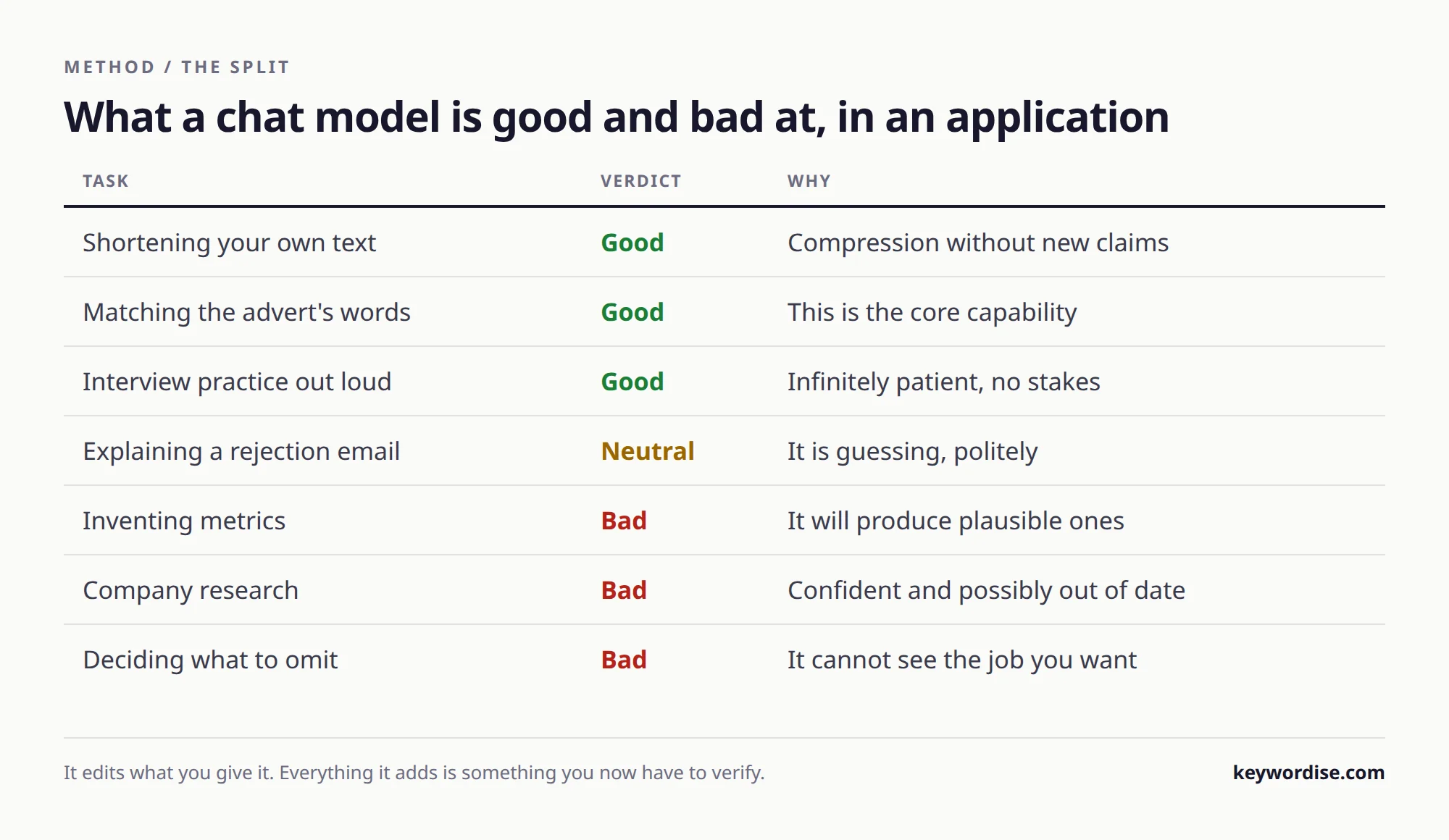
It is reliable while it edits facts you supplied and unreliable the moment it has to supply one. Everything it adds is something you now have to check.
The line that runs through every use
Sources
Every source here was fetched and checked before it was linked. Our own parser numbers are reproducible: render the same CV in both layouts and extract it.
- Huntr, how applicant tracking systems actually work (1.7M+ applications analysed)
- ResumeAdapter, where the 75% rejection figure actually comes from
- European Commission, AI Act
- Your Europe, data protection and online privacy
Stop sending the same CV
Keywordise writes a fresh, truthful CV for every job and applies for you. 7-day free trial, 5 free applications, no card.
Start free →Frequently asked questions
Can I use ChatGPT to write my job application?
For arranging, shortening and matching your own material to a posting, yes. For producing content about work you have not described to it, no: it has no facts, so it supplies plausible ones and states them confidently.
What is a good ChatGPT prompt for a CV?
Paste your real bullets with the numbers first, then the posting, then instruct it to use only facts present above, invent nothing, and leave gaps as gaps. Ask it to flag any sentence it could not source from your material.
Will employers know I used ChatGPT?
Detection tools are unreliable, but a human notices a document that does not sound like you, and the interview is where that costs you. Keep your phrasing and your numbers.
Is it safe to paste my CV into ChatGPT?
Treat it as sending the document to a third party, because that is what it is. Remove your address and phone number before pasting if that matters to you; the tailoring works the same without them.
Can ChatGPT make my CV ATS friendly?
It can fix wording and headings. It cannot fix the file, and the file is where most applications fail. Export, paste into a plain text editor and check your name is the first line.
Should I let ChatGPT estimate numbers I forgot?
No. It will produce a confident figure that is fiction, and a borrowed number collapses in the interview and takes your true ones with it. Leave the gap or go and find the real number.
Does it work in German and Dutch?
Yes, and the same split applies: good at arrangement, bad at facts. Check idiom carefully in both, because a model will produce grammatical text that a native speaker can tell was translated.
Is a paid tool better than ChatGPT for this?
For one document, no. A paid tool earns its place on repetition and on producing a file that parses, which is the part a chat window does not do.
Cite this article
Free to quote with a link to this page.
APA Keywordise. (2026, September 19). ChatGPT for job applications: what it does well and badly. Keywordise. https://keywordise.com/blog/chatgpt-for-job-applications
MLA Keywordise. “ChatGPT for job applications: what it does well and badly.” Keywordise, 19 Sep. 2026, https://keywordise.com/blog/chatgpt-for-job-applications.