CV conventions in Germany, Austria and Switzerland

DACH is treated as one market and it is three conventions. A CV that is normal in Germany sends small wrong signals in Austria, and Switzerland differs again.
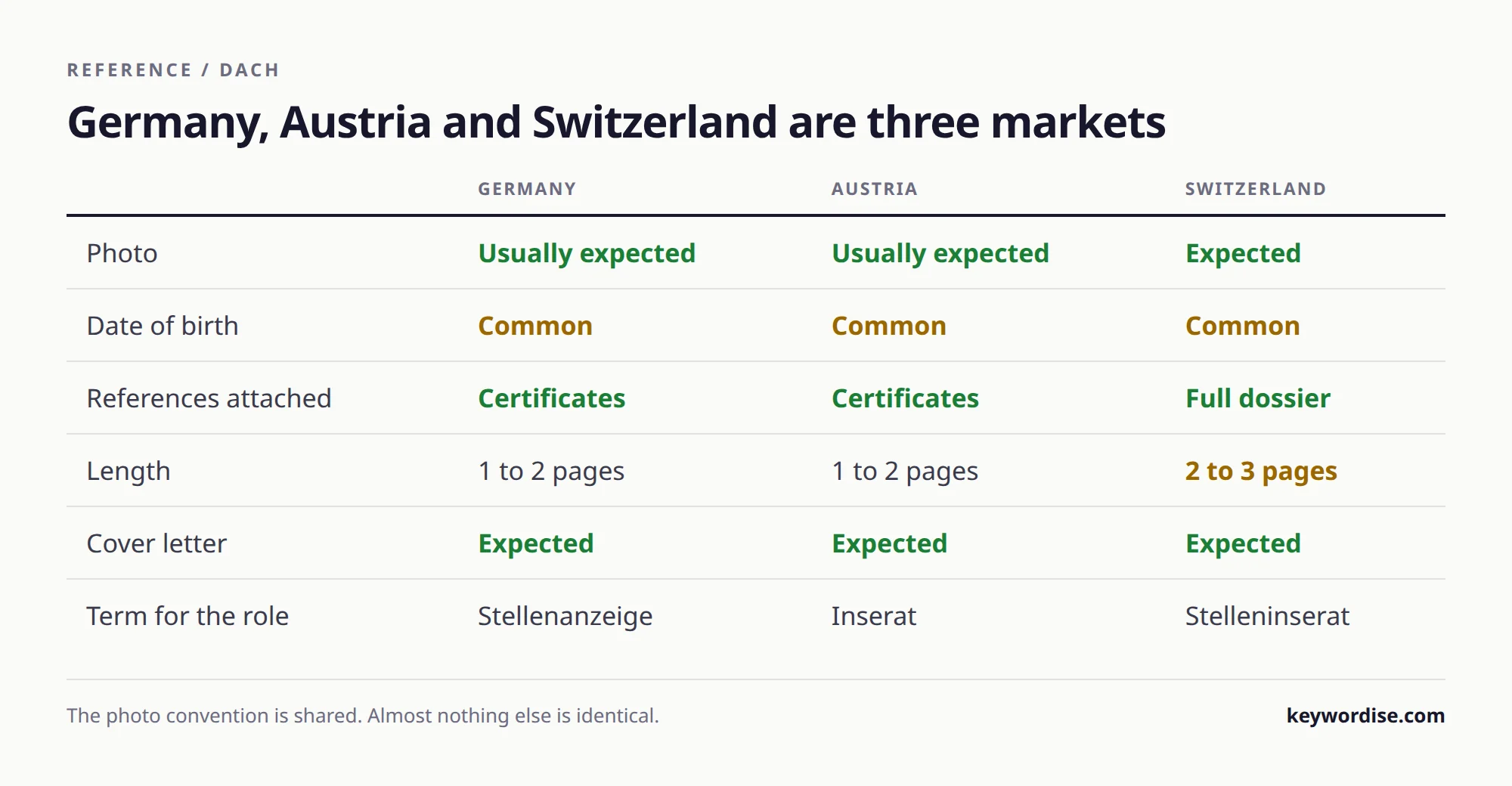
DACH is a convenient label for three countries that share a language and not much else about hiring. The photo convention is genuinely shared, which is what makes the differences easy to miss: the document looks right, and then the wrong things are attached to it.
What the three markets share
A photo, a reverse chronological table, a cover letter and MM.YYYY dates are standard in all three. That is already four conventions the UK and the US treat as wrong, which is why a CV written for London needs real work before it goes to Zurich.
Switzerland asks for a dossier, not a CV
The Swiss application is the outlier. Where a German employer expects a CV, a letter and your certificates, a Swiss employer expects a complete dossier: the letter, the CV, every reference letter from every previous employer, and the diplomas, assembled in order as one file. An application missing the reference letters reads as incomplete rather than concise.
Sharing a language is not sharing a hiring culture. The Swiss dossier and the German Bewerbung are different documents wearing the same vocabulary.
Working rule behind the market table above
Austria: the same shape, a different vocabulary
An Austrian application looks like a German one and does not read like one. The vocabulary differs in places that matter on a CV, and using the German word is the quietest way to signal that the document was written for a different country.
| Germany | Austria | On the CV this appears as |
|---|---|---|
| Abitur | Matura | The school leaving qualification |
| Ausbildung | Lehre | The apprenticeship line |
| Stellenanzeige | Inserat | What you say you are responding to |
| Bewerbungsunterlagen | Bewerbungsunterlagen | One of the few shared terms |
| Januar | Jänner | The month, in a date range |
The photo is a convention, not a requirement
German anti-discrimination law does not require a photo and a growing number of larger employers ask for applications without one. The convention is still strong enough that omitting it without being asked reads as unusual in Germany and Austria, and more so in Switzerland. Follow the advert: if it says anonymised, it means it.
What software reads, in all three
The photo does not break the parse. The layout around it does. A photo floated beside single-column text extracts identically to the same CV without it. A photo anchoring a sidebar is a different matter, because the sidebar is the problem: we measured a two-column CV at 4 of 9 parser checks against 9 of 9 for one column. See what actually parses.
- One column, with the photo floated beside the text rather than holding up a sidebar.
- Standard headings: Berufserfahrung, Ausbildung, Kenntnisse.
- MM.YYYY throughout, and Jaenner spelled Jänner for Austria.
- Language levels on the CEFR scale, not as adjectives.
- For Switzerland, assemble the full dossier as one PDF in the expected order.
Sources
Every source here was fetched and checked before it was linked. The photo and document conventions below are described as they are practised, not as any single employer requires them.
- Europass, the CEFR levels used for the language line on a German CV
- Huntr, how applicant tracking systems actually work
- ResumeSquad, how the major ATS platforms differ in parsing
Stop sending the same CV
Keywordise writes a fresh, truthful CV for every job and applies for you. 7-day free trial, 27 free applications, no card.
Start free →Frequently asked questions
Is a German CV the same as an Austrian one?
The shape is the same and the vocabulary is not. Matura rather than Abitur, Lehre rather than Ausbildung, Inserat rather than Stellenanzeige, and Jänner rather than Januar in a date.
Do I need a photo on a German CV?
It is not required by law and it is still the convention. A growing number of large employers ask for applications without one, and when the advert says anonymised, follow the advert.
What is different about a Swiss application?
Switzerland expects a complete dossier: cover letter, CV, every reference letter from every previous employer, and diplomas, assembled in order as one file. Leaving the reference letters out reads as incomplete.
How long should a CV be in the DACH region?
One to two pages in Germany and Austria. Swiss dossiers run longer because the attachments are part of the expected document, not extras.
Does a photo break an ATS parse?
Not on its own. We measured a floated photo beside single-column text as extracting identically to the same CV without it. The sidebar that a photo often sits in is the real problem.
Is a cover letter still expected?
Yes, in all three countries, and it is read. This is the clearest difference from the UK and the US, where it is increasingly optional.
How do I write language levels for a German employer?
On the CEFR scale: Deutsch C1, Englisch B2. The scale is European and understood in all three countries, which adjectives are not.
Should I include my date of birth?
It remains common across all three countries, unlike the UK and the US where it is a liability. It is not required, and omitting it is no longer remarkable.